




Museum · Contemporary
Tate Modern

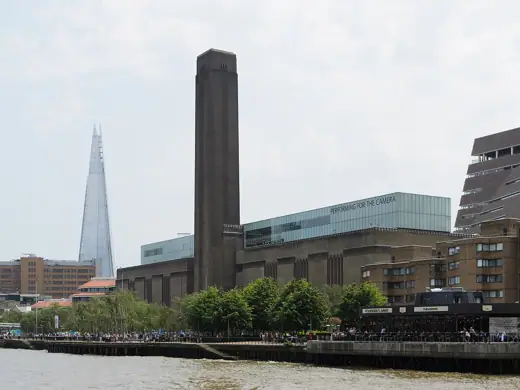
Key featuresA power station turned museum; the Turbine Hall became an indoor street.
About the building
Tate Modern is the London gallery that houses Britain's national collection of modern and contemporary art from around the world, made from 1900 onwards. It fills a former power station by Sir Giles Gilbert Scott, who also designed Battersea Power Station, built in two phases between 1947 and 1963: a steel-framed, brick-clad building 200 m long with a central chimney 99 m tall. Jacques Herzog and Pierre de Meuron were named winners of the commission in January 1995. Their conversion kept much of the original interior structure, including the vast turbine hall with its overhead travelling crane. The most visible change outside is a two-storey glass extension along half of the roof. The Queen opened the gallery on 11 May 2000, and 5.25 million people visited in its first year.
Sources: Tate Modern (Wikipedia)
More by Herzog & de MeuronAll 32 →
More with adaptive reuseAll 195 →
Find more with
Adaptive reuse195 buildings →Public space617 buildings →Brick332 buildings →Museum735 buildings →Each opens every building that shares the idea.
Details
- Year
- 2000
- Typology
- Museum
- Movement
- Contemporary
- Region
- Europe
Go deeper





More · MuseumAll 735 →

Portrait: Columbia GSAPP · CC BY 2.0 · source