Guide · Juries
Architecture jury presentation tips: what to show and what to say
A jury is not an exam you pass by covering everything. It is a short conversation about whether your idea holds up, and whether you understand your own project. The best presentations open with the idea in a sentence, walk through the drawings in the order they are pinned, and leave time for the conversation that follows.
What the jury is actually doing
Put yourself on the other side of the table. The jurors have probably seen many projects that day, often on the same site and the same brief. They will look at your board before you say a word, and they will form a first impression in the time it takes you to unpack your notes.
What they are looking for is simple to state and hard to fake: a clear intention, drawings that prove it, and a student who can think on their feet when the scheme is questioned. They are not looking for every iteration you made, and they are not counting hours.
Open with the idea, in one or two sentences
Your first thirty seconds matter more than any other part. Don't start with "So, my site is located in…". Start with what the project does.
Compare these two openings for a library on a busy street. "My site is on the corner of two roads and the brief was a public library of about 2,000 square metres." Or: "This library treats the street as its reading room: the ground floor is an open, shaded porch where anyone can sit, and the quieter rooms stack above it." The second tells the jury what to look for in every drawing that follows. The brief and the site come next, briefly, as the reasons for the idea.
If you can't say the idea in two sentences, practise until you can. It is the single most useful thing you can do before a jury.
Talk in the order your board is pinned
Your board (and your deck, if you have one) should already be laid out in the order you explain the project: idea, site, hero view, plans, sections, details. Then the talk is simple: you walk the jury across the board from top left to bottom right.
A shape that works for most five-to-ten-minute presentations:
- The idea in one or two sentences, with the hero image.
- The site and the brief, only as much as explains the idea: what the site gave you, what problem you took on.
- The walk-through: plans and sections, told as a person moving through the building. Enter, turn, climb, arrive.
- One moment you care about most: a room, a threshold, a detail. Slow down here.
- What is unresolved and what you would do next. Saying it yourself is stronger than waiting for the jury to find it.
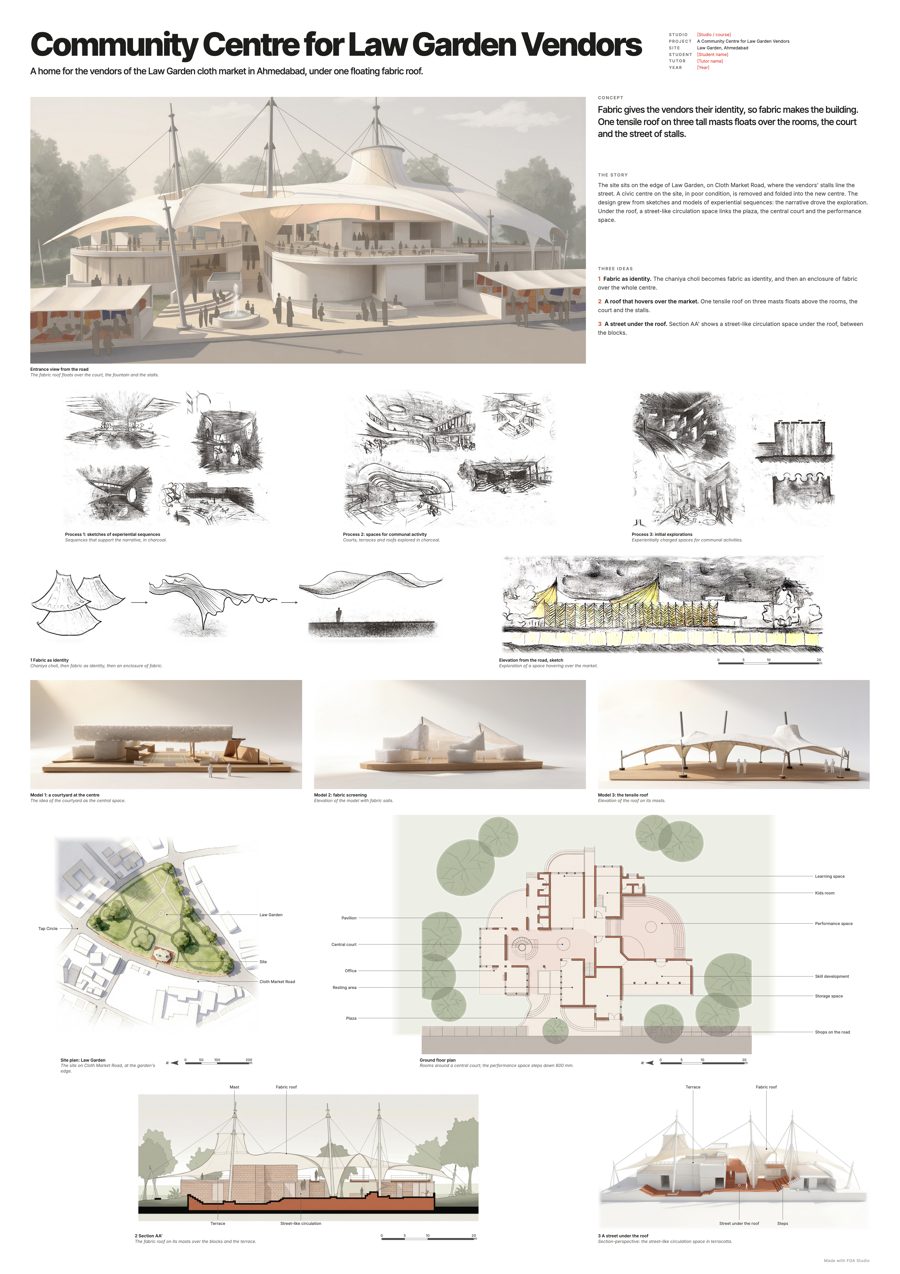
If your talk and your board disagree on order, the jury spends its attention searching rather than listening. Lay the board out to match the talk; our A1 layout guide shows how.
Point at the drawings, not at your notes
Stand beside the board, not in front of it. When you say "the entrance", put your hand on the entrance in the plan. When you say "light comes from above", point to the section. This keeps the jury looking where you need them to, and it forces you to talk about the building rather than recite a script.
Notes are fine on a small card: the opening sentence, the order, and the one moment you want to slow down on. Reading full sentences from a phone or a sheet pulls your eyes away from the people you are talking to.
Say what the drawing shows, not what it is
"This is the ground floor plan" tells a juror nothing they can't see. "On the ground floor, the reading porch opens fully to the street, and the stair is the only way up, so everyone passes the courtyard" tells them why the drawing exists. The same goes for captions on the board: they should say what to look at.
What to leave out
- Your whole process. One or two process images that explain a turning point are useful. A chronological tour of every model is not.
- Software talk. Nobody needs to know which program made the render.
- Apologies. "I didn't have time to finish the elevations" uses up your time and points the jury straight at the gap. If something is missing, say what you would show there and move on.
- Things you can't explain. If a drawing or image is on the board, be ready to talk about it. If you can't, it probably shouldn't be there.
- A tour of precedents. If one shaped your design, show it small and say in one sentence what you took from it. Our guide to doing a precedent study explains how to find that sentence.
Handling questions and criticism
The conversation after your talk is where most of the learning happens, and it is the part students fear most. A few habits help:
- Listen to the whole question. Don't start answering after the first five words. Jurors often arrive at their real point at the end.
- Repeat it briefly if it is complicated: "So you're asking whether the courtyard gets enough sun in winter?" It buys you a moment and checks you understood.
- Answer the question asked. If you don't know, say so, and say how you would find out: "I haven't tested that. I would check it with a sun study in section."
- Don't defend everything. If a juror spots a real weakness, agreeing with it and suggesting a fix shows more design maturity than arguing.
- Ask a friend to write notes. You won't remember the useful comments afterwards, and you will be too busy listening to write.
Disagreement between jurors is normal. You don't need to settle it; you need to understand both views.
Practise out loud, with a timer
Rehearse at least twice, standing up, out loud, with a timer. The first run is always longer than you think: three minutes of talking is only about 400 words, far less than most students prepare. Cut until you finish with time to spare. Then list the five questions you most fear and answer each one in a sentence or two. The 48-hour pre-jury plan leaves time for exactly this.
What to bring
- Pins, tape or clips for the board, in case the wall has none.
- An A3 print of your drawings for yourself, so you can glance at it without turning your back on the jury.
- Your model, protected for the journey.
- The deck as a PDF on a USB stick and online, if the jury uses a screen, plus your own adapter.
- A small card with your opening sentence and the order of your talk.
- A notebook, or a friend who will write down what the jury says. Comments that felt harsh in the room are often the most useful at your desk the next day.
Questions students ask
How long should an architecture jury presentation be?
Follow the time your studio sets, which is often somewhere between five and fifteen minutes before questions. Plan to finish a little early: a shorter, clearer talk leaves more time for the conversation, which is where the useful feedback comes from.
How should I start my jury presentation?
With the idea of the project in one or two sentences, while the jury looks at your hero image. Bring in the site and the brief next, briefly, as the reasons for that idea.
What if I don't know the answer to a juror's question?
Say so plainly, then say how you would find out or what you would test. Jurors respond far better to honest thinking than to a confident guess.
What is the difference between a jury and a crit?
Usually nothing: both are reviews of your project by tutors and invited guests. Schools use different words for the same thing (jury, crit, review, final review, pin-up), and some keep "jury" for the formal end-of-term review.
Should I use slides or only the board?
Follow what your school expects. If there is a screen, a short deck that follows the board's order helps everyone see the drawing you are talking about; see how to structure a jury deck.