


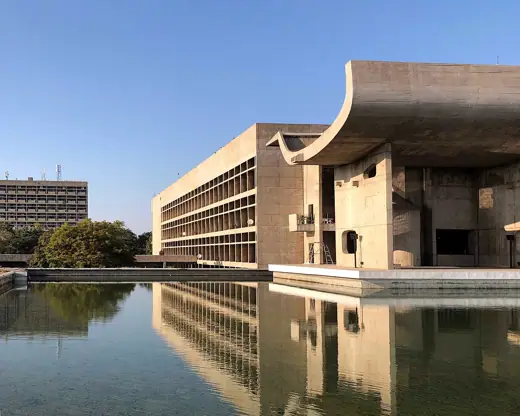


Civic · Brutalism
Palace of Assembly

Key featuresA parliament built for the Punjab sun: portico, brise-soleil and a hyperboloid chamber.
About the building
Le Corbusier designed the Palace of Assembly in Chandigarh, home to both the Punjab and the Haryana Legislative Assemblies. It belongs to the city's Capitol Complex, alongside the Secretariat and the High Court. Work began in 1951 and ended in 1962, eleven years later, and the building was inaugurated on 15 April 1964. The assembly chamber is circular and set off-centre in the plan, a move that questions the ordered layouts of neoclassical architecture. There is also a forum for conversation and business. Ramps take the place of stairs, so movement between levels flows without steps, while tall ceilings and slim columns make the interior feel open. The main door, close to 2.3 square metres with enamelled panels, was flown in from Paris. Since 2016 the building has been part of a UNESCO World Heritage Site.
Sources: Palace of Assembly (Wikipedia)
More by Le CorbusierAll 34 →

More with brise-soleilAll 66 →
DocumentariesAll documentaries →
Find more with
Brise-soleil66 buildings →Monumentality909 buildings →Climate response258 buildings →Civic375 buildings →Each opens every building that shares the idea.
Details
- Place
- Chandigarh, India
- Year
- 1962
- Typology
- Civic
- Movement
- Brutalism
- Region
- South Asia
Go deeper





See all 8 links


More · CivicAll 375 →
Portrait: Joop van Bilsen for Anefo · CC0 · source