




Culture & sport · Brutalism
Hong Kong Coliseum
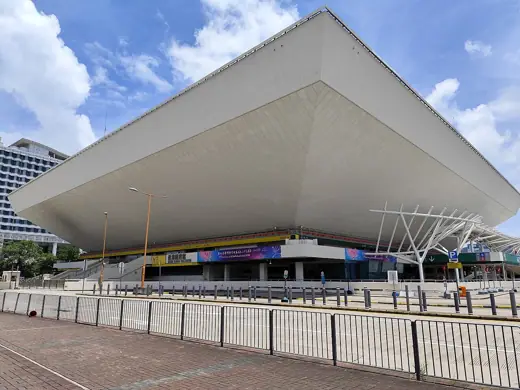
Key featuresIndoor arena shaped like an inverted pyramid, its huge sloping bowl lifted over a glazed base.
About the building
Better known as the Hung Hom Coliseum, the Hong Kong Coliseum is an indoor arena for many uses on Hung Hom Bay in Kowloon, close to Hung Hom station. It was built by the Urban Council and opened officially on 27 April 1983. Its main designer is considered to be Pau Shiu-hung, once Director of Architectural Services for the HKSAR Government. Seats surround the rectangular arena floor on all four sides, with the top and most distant rows reaching 41 metres up. For shows, the floor can be laid with different coverings, such as removable wooden flooring or rubber roll-outs of several kinds. For students, it is a compact study in how seating on all four sides of a flexible floor can serve many uses.
Sources: Hong Kong Coliseum (Wikipedia)
More with cantileverAll 180 →

Find more with
Cantilever180 buildings →Structure as expression668 buildings →Monumentality909 buildings →Culture & sport614 buildings →Each opens every building that shares the idea.
Details
- Architect
- Pau Shiu-hung (Architectural Services Department)
- Place
- Hong Kong, Hong Kong
- Year
- 1983
- Typology
- Culture & sport
- Movement
- Brutalism
- Region
- East Asia

Go deeper





See all 8 links


More · Culture & sportAll 614 →


Portrait: Unknown author · CC BY-SA 2.5 · source