

Culture & sport · Modernism
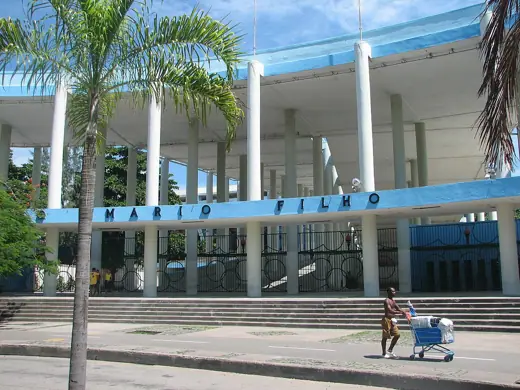
Maracanã Stadium
Key featuresOpened in 1950 and then the world's largest stadium; construction was only finished in 1965.
About the building
Officially the Estádio Jornalista Mário Filho, this football ground in Rio de Janeiro is owned by the state government and run by the Flamengo and Fluminense clubs. The city opened a competition to design and build it in 1947, and the contract went to a group including Waldir Ramos, Raphael Galvão and Antônio Dias Carneiro. It opened for the 1950 World Cup, and on 16 July Uruguay beat Brazil 2–1 in the deciding game before 173,850 people, a record that still stands. It overtook Hampden Park as the world's largest stadium, yet was fully completed only in 1965. A rebuild began in 2010 ahead of the 2014 World Cup and 2016 Olympics: a mostly single-tier bowl for 78,639 replaced the old two-tier one, and a coated fibreglass membrane took over from the concrete roof, now sheltering 95 percent of seats.
Sources: Maracanã Stadium (Wikipedia)
More with structure as expressionAll 668 →
Find more with
Structure as expression668 buildings →Monumentality909 buildings →Geometry1061 buildings →Culture & sport614 buildings →Each opens every building that shares the idea.
Details
- Architect
- Waldir Ramos, Raphael Galvão, Miguel Feldman, Oscar Valdetaro, Pedro Paulo B. Bastos, Orlando Azevedo, Antônio Dias Carneiro
- Place
- Rio de Janeiro, Brazil
- Year
- 1950
- Typology
- Culture & sport
- Movement
- Modernism
- Region
- Americas