
Culture & sport · Brutalism
Miami Marine Stadium
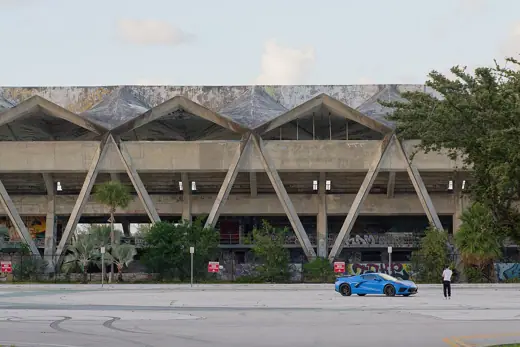
Key featuresConcrete grandstand for 6,566 under a cantilevered folded-plate roof on eight slanted columns, facing a boat basin.
About the building
Miami Marine Stadium, finished in 1963 on land the Matheson family gave the City of Miami for water sports, is the first US stadium built for powerboat racing. Its architect, Hilario Candela, was 28 and newly arrived from Cuba; his firm's work with his distant relative Félix Candela on a Bacardí warehouse in Mexico, and internships with Max Borges Jr., architect of Havana's Tropicana Club, shaped his approach. All in concrete, its folded plate roof cantilevers from eight slanting columns anchored through the grandstand and joined by a long beam. The columns stand well back to keep views of the water clear, and a gap in the seats reveals their height. After Hurricane Andrew it was declared unsafe and abandoned in 1992. It was named a National Treasure in 2012 and joined the National Register of Historic Places in 2018.
Sources: Miami Marine Stadium · Hilario Candela (Wikipedia)
More with structure as expressionAll 668 →


Find more with
Structure as expression668 buildings →Cantilever180 buildings →Water306 buildings →Culture & sport614 buildings →Each opens every building that shares the idea.
Details
- Architect
- Hilario Candela
- Place
- Miami, United States
- Year
- 1963
- Typology
- Culture & sport
- Movement
- Brutalism
- Region
- Americas

Go deeper





See all 7 links

More · Culture & sportAll 614 →
Portrait: REVILL97 · CC BY-SA 4.0 · source