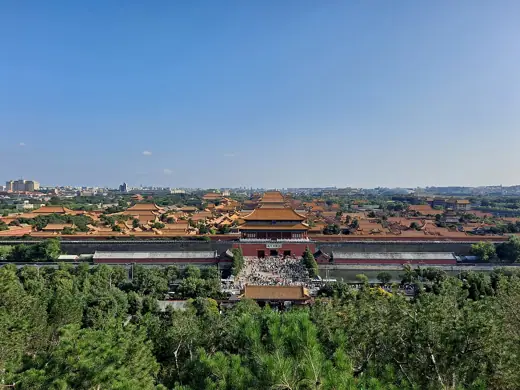
1/7 · Exterior · Beijing, 1991; digital copy of slidePhoto: Gary Todd from Xinzheng, China · CC0 · source2/7 · Exterior · Views of the Forbidden City from Jingshan ParkPhoto: EditQ · CC BY-SA 4.0 · source3/7 · Exterior · Tiananmen Square & Forbidden City- Beijing, China, Sept 28 2017Photo: Kyla Duhamel from Saskatoon, Canada · CC BY 2.0 · source4/7 · Exterior · Beijing, Forbidden City, 1986Photo: Reinhold Möller Ermell · CC BY-SA 4.0 · source5/7 · Interior · The Hall of Military Eminence in the Forbidden CityPhoto: Balon Greyjoy · CC0 · source6/7 · Interior · The Hall of Military Eminence in the Forbidden CityPhoto: Balon Greyjoy · CC0 · source7/7 · PlanPhoto: Unknown author · Public domain · source
Key featuresWalled and moated palace city of 980 buildings strung along Beijing's north-south axis.
About the building
Built between 1406 and 1420, the Forbidden City is the palace complex at the heart of the Imperial City in Beijing. From the Ming dynasty until the Qing dynasty ended in 1924 it was the emperor's palace and winter residence. The plan is a rectangle measuring 961 m north to south and 753 m east to west, enclosed by a 7.9 m wall and a moat 52 m wide and 6 m deep. The Outer Court to the south held ceremonies, while the Inner Court to the north housed the emperor's family and daily state business. A stone path, the Imperial Way, forms the central axis of both palace and city. Every scale of the design was planned to express philosophical and religious ideas and imperial power. UNESCO listed it as a World Heritage Site in 1987.
The Forbidden City is the imperial palace complex in the center of the Imperial City in Beijing, China. It was the residence of twenty-four Ming and Qing dynasty Emperors and was the center of political power in China from 1420 to 1924. The palace is now administered by the Palace Museum and has been an UNESCO World Heritage Site since 1987. The Forbidden City is one of the most famous palaces in all of Chinese history and is the largest preserved royal palace complex still standing in the world.
Bernardo Bertolucci's The Last Emperor was filmed inside the Forbidden City in 1987 (and was the first Western production to do so).
The Forbidden City was constructed from 1406 to 1420 and was the imperial palace and winter residence of the Emperor of China from the Ming dynasty (since the Yongle Emperor in 1420) to the end of the Qing dynasty in 1924. Serving as the home of Chinese emperors and their households, the Forbidden City was the ceremonial and political center of the Chinese government for over 500 years. Since 1925, the Forbidden City has been under the charge of the Palace Museum, whose extensive collection of artwork and artifacts was built upon the imperial collections of the Ming and Qing dynasties.