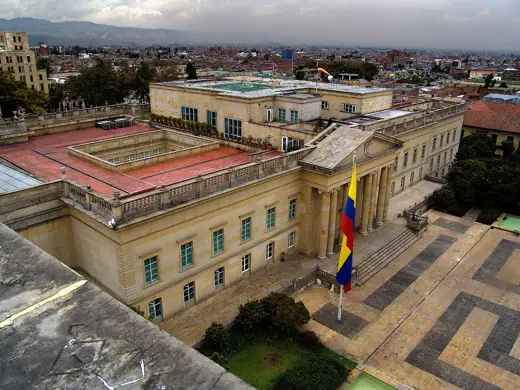
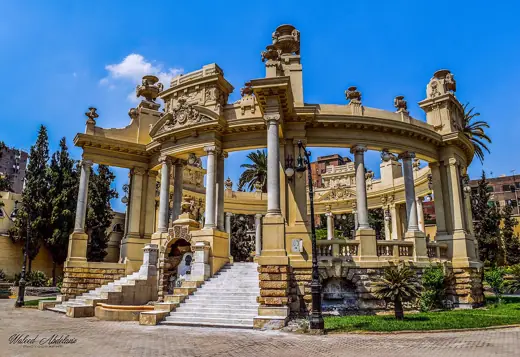
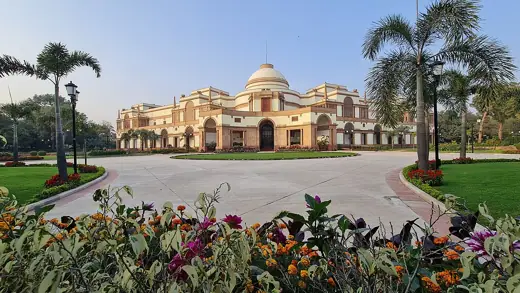
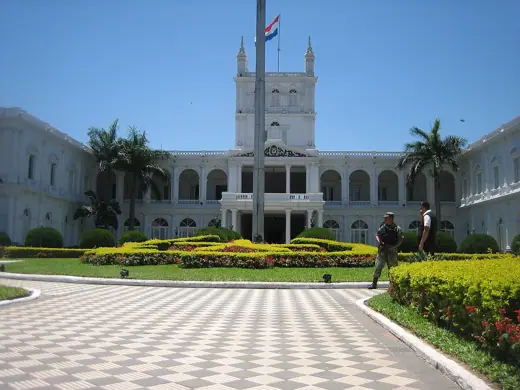
1/5 · Context · The President Of Colombia HousePhoto: Miguel Olaya from Bogotá, Colombia · CC BY-SA 2.0 · source2/5 · ExteriorPhoto: EEIM · CC BY-SA 3.0 · source3/5 · ExteriorPhoto: Juanjo70000 · CC BY-SA 4.0 · source4/5 · Exterior · 20230628 Día LGBTIQ+ Casa de Nariño-Cesar CarrionPhoto: FotoPresidencia · Public domain · source5/5 · Detail · Casa de Nariño y la obra "Vigilantes" del escultor Edgar NegretPhoto: Alejandro Rojas SajoR · CC BY-SA 4.0 · source
Key featuresPresidential palace of Colombia in Bogotá, completed 1908.
About the building
The President of Colombia lives and works in the Casa de Nariño in Bogotá. Its name means the House of Nariño; it was built on the site of the house where Antonio Nariño was born and dedicated in 1908. Julián Lombana and Gastón Lelarge, who was born in France and had studied under Charles Garnier, designed it. They pushed the property out as far as Eighth Road, reorganised the inside on two levels, laid out wide halls and gave the front carved stone. The Swiss sculptor Luigi Ramelli made all the ornament. New additions led to a second dedication in 1980. Fernando Alsina, an architect and auditor at the Ministry of public works, handled restoration. In the garden stands the Observatorio Astronómico de Bogotá, built in 1802–03 to a design by Domingo de Petrés, a Capuchin friar and architect.
The Casa de Nariño (Spanish pronunciation: ['kasa ðe na'riɲo]), literally the House of Nariño, is the official residence and principal workplace of the President of Colombia. It houses the main office of the executive branch and is located in the capital city of Bogotá, Colombia. It was dedicated in 1908 after being constructed on the site of the house where Antonio Nariño was born. The design was made by architects Gastón Lelarge, a French-born former pupil of Charles Garnier, and Julián Lombana.
On the north side of the palace, is the Plaza de Armas (Parade Square), a place where foreign guests are received with military honors. On the north side of this square are two sculptures: A replica of the pre-Columbian anthropomorphic stone sculpture called "El dios de la muerte" (Spanish for the God of Death), whose original can be found in the San Agustin Archaeological Park, and also, a sculpture by Édgar Negret in 1979 titled "Vigilantes", it is composed of 10 red bent aluminum plates and is dedicated to love and feelings. On the west side of the square are the fountain and the flagpole.