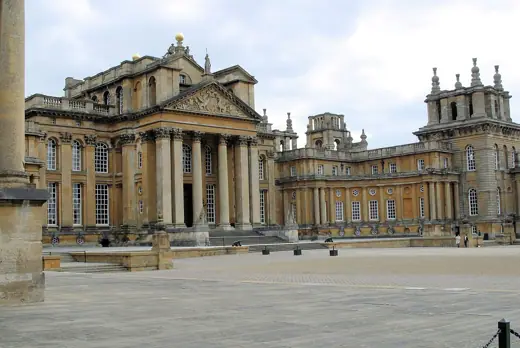
1/7 · Exterior · An exercise in English BaroquePhoto: Stuart Logan · CC BY-SA 2.0 · source2/7 · Exterior · Blenheim, Blenheim PalacePhoto: Balon Greyjoy · CC BY-SA 4.0 · source3/7 · Exterior · Blenheim Palace from the Water Terraces, a World Heritage SitePhoto: DeFacto · CC BY-SA 4.0 · source4/7 · Exterior · The facade of Blenheim Palace from the South Lawn, a World Heritage SitePhoto: DeFacto · CC BY-SA 4.0 · source5/7 · Interior · Bleinham Palace 1980Photo: Johnckarnes · CC BY-SA 4.0 · source6/7 · Interior · Ai Weiwei's He Xie at Blenheim Palace, 2014Photo: Helenneven · CC BY-SA 4.0 · source7/7 · Elevation · Blenheim Palace, south west elevationPhoto: David P Howard · CC BY-SA 2.0 · source
Key featuresCountry house with a monumental triumphal-arch East Gate and low corner towers crowned with belvederes of massed stone.
About the building
Home to the Dukes of Marlborough, this Oxfordshire country house is also where Sir Winston Churchill was born. It takes its name from the 1704 Battle of Blenheim and was meant to reward the 1st Duke for beating French and Bavarian forces in the War of the Spanish Succession. One of England's largest houses, it rose in 1705–1722. John Vanbrugh was a popular playwright with no architectural training, and he usually teamed up with the trained, practical Nicholas Hawksmoor; the pair had just completed early stages of Castle Howard. Vanbrugh designed Blenheim to be viewed from afar, which a site of some seven acres also requires. His Baroque is severe: heavy masses of stone suggest strength and throw shadows that act as ornament, while three blocks make up the Great Court, meant to overwhelm arrivals. UNESCO listed it in 1987.
Portrait: Godfrey Kneller · Public domain · source
About Blenheim Palace
Blenheim Palace ( BLEN-im) is a country house in Woodstock, Oxfordshire, England. It is the seat of the Dukes of Marlborough, and the birthplace of Sir Winston Churchill. Originally called Blenheim Castle, it has been known as Blenheim Palace since the 19th century. One of England's largest houses, it was built between 1705 and 1722, and was designated a UNESCO World Heritage Site in 1987.
The palace is named after the 1704 Battle of Blenheim. It was originally intended to be a reward to the 1st Duke of Marlborough for his military triumphs against the French and Bavarians in the War of the Spanish Succession, which culminated in the eponymous battle near the town of Blenheim in what is today southern Germany.
The land on which the Palace sits was given as a gift, and construction began in 1705, with some financial support from Queen Anne. The project soon became the subject of political infighting and controversy, with the Crown cancelling further financial support in 1712, Marlborough's three-year voluntary exile to the Continent, the fall from royal influence of his wife, and lasting damage to the reputation of the architect Sir John Vanbrugh. Designed in the rare, and short-lived, English Baroque style, the palace elicits architectural assessments as divided today as they were in the 1720s.