




Housing · Modernism
Unite d'Habitation Berlin

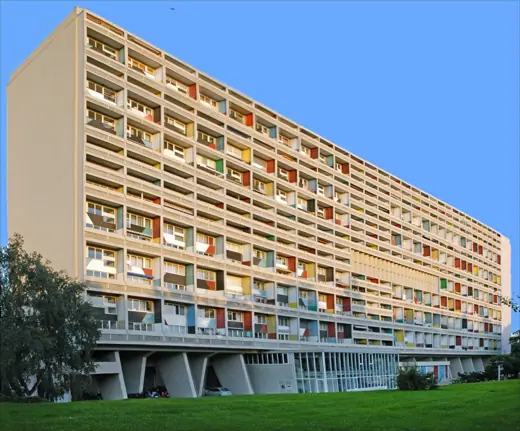
Key featuresSlab block on pilotis whose Modulor ceiling heights were raised to meet German codes.
About the building
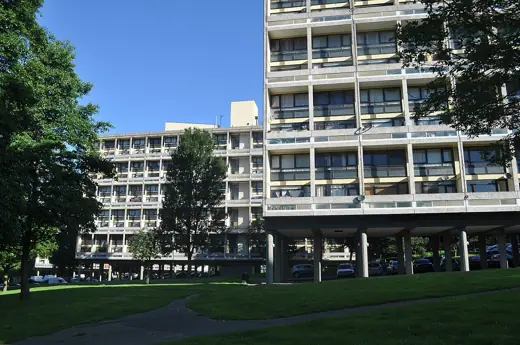
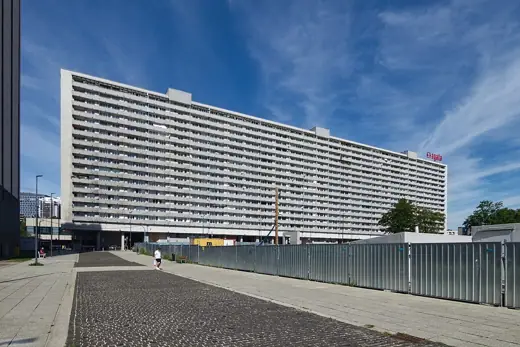
Le Corbusier named this 1958 apartment block in Berlin-Westend (Charlottenburg-Wilmersdorf) Unité d'habitation 'Typ Berlin'; it follows his Unité d'Habitation concept and was later called the Corbusierhaus. It was planned in connection with Interbau 57, Berlin's 1957 international housing exhibition. Of the empty lots the city offered, he chose one between the stadium of the 1936 Olympics and a huge mound of rubble from wartime ruins. On the sandy ground, the ground-floor pilotis had to be doubled for stability. Built in béton brut, it belongs to the early phase of brutalism. A height Le Corbusier set at 226 cm became 250 cm, changing the whole structure and the flats. Seventeen floors hold 530 flats, against 337 in the 1952 Marseille Unité. The work was later removed from his oeuvre, and it has been a protected monument in Berlin since 1996.
Sources: Unité d'Habitation of Berlin (Wikipedia)
More by Le CorbusierAll 34 →
More with pilotisAll 68 →
DocumentariesAll documentaries →
Find more with
Pilotis68 buildings →Modular104 buildings →Section190 buildings →Housing264 buildings →Each opens every building that shares the idea.
Details
- Place
- Berlin, Germany
- Year
- 1958
- Typology
- Housing
- Movement
- Modernism
- Region
- Europe
Go deeper




See all 9 links


More · HousingAll 264 →
Portrait: Joop van Bilsen for Anefo · CC0 · source