
Museum · Contemporary
Sursock Museum
Key features1912 villa expanded with four new underground floors beneath the garden; reopened 8 October 2015.
About the building
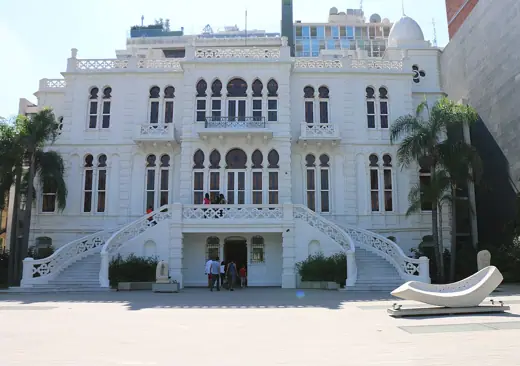
This Beirut museum of modern and contemporary art occupies a villa that Nicolas Ibrahim Sursock, a Lebanese aristocrat, built in 1912 and left in his will to become a museum. With its Venetian and Ottoman influences, the house is an example of Lebanese architecture and one of the few villas of its time left in the city. The museum opened in 1961 with a show of contemporary Lebanese artists. The French architect Jean-Michel Wilmotte and the Lebanese architect Jacques Abou Khaled later designed an extension of four floors below the garden, costing US$12 million. It grew the museum from 1,500 to 8,500 square metres, adding galleries, a research library, an auditorium, a restoration workshop and a restaurant, and the museum reopened in October 2015. The explosion of 4 August 2020 caused serious damage, and 57 artworks had to be restored.
Sources: Sursock Museum (Wikipedia)
More with adaptive reuseAll 195 →
Find more with
Adaptive reuse195 buildings →Void104 buildings →Light & shadow431 buildings →Museum735 buildings →Each opens every building that shares the idea.
Details
- Architect
- Jean-Michel Wilmotte and Jacques Abou Khaled (extension)
- Place
- Beirut, Lebanon
- Year
- 2015
- Typology
- Museum
- Movement
- Contemporary
- Region
- Middle East

Go deeper





See all 8 links


More · MuseumAll 735 →
Portrait: Wilmotteetassocies · CC BY-SA 4.0 · source