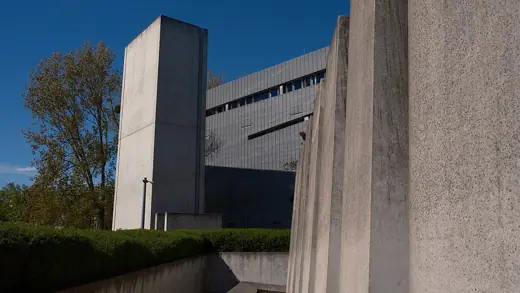
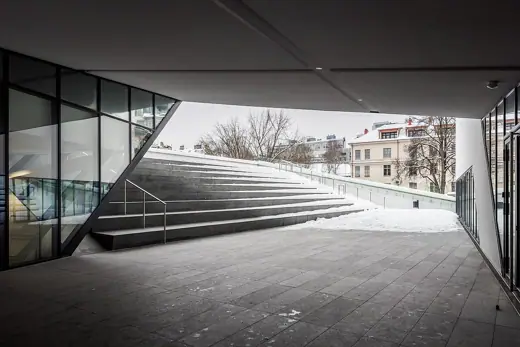
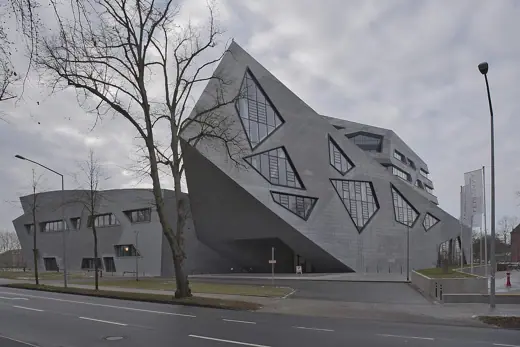
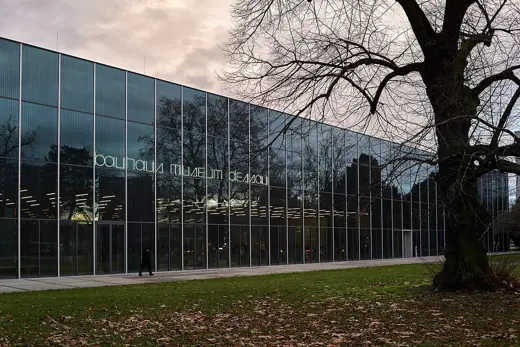
1/10 · ExteriorPhoto: Ziko van Dijk · CC BY-SA 4.0 · source2/10 · ExteriorPhoto: Ziko van Dijk · CC BY-SA 4.0 · source3/10 · InteriorPhoto: Ziko van Dijk · CC BY-SA 4.0 · source4/10 · InteriorPhoto: Ziko van Dijk · CC BY-SA 4.0 · source5/10 · InteriorPhoto: Ziko van Dijk · CC BY-SA 4.0 · source6/10 · DetailPhoto: Ziko van Dijk · CC BY-SA 4.0 · source7/10 · ContextPhoto: Ziko van Dijk · CC BY-SA 4.0 · source8/10 · ContextPhoto: Ziko van Dijk · CC BY-SA 4.0 · source9/10 · Model · Model of Jüdisches Museum Berlin (Jewish Museum Berlin) by Daniel LibeskindPhoto: Naotake Murayama · CC BY 2.0 · sourcePhotos unavailable10/10Moleskine · CC BY 4.0 · source
Key featuresA zigzag plan cut through by empty 'voids' that visitors can see but not enter.
About the building
The Jewish Museum Berlin is Europe's largest Jewish museum. Against other entrants' cool, neutral spaces, Daniel Libeskind proposed a radical zigzag nicknamed "Blitz" (lightning). The twisting building is reachable only by a tunnel from the old building. A line of empty "Voids", about 20 m (66 ft) tall, slices through it. Three axes stand for the paths Jewish life in Germany has taken: continuity within German history, emigration, and the Holocaust. The second leads to the Garden of Exile, set on tilted ground, where oleaster grows high above reach on 49 pillars; 48 hold Berlin soil and one holds soil from Jerusalem. The bare concrete Tower, unheated and uncooled, is lit only by a small slit in the roof. Finished empty in 1999, it drew over 350,000 visitors before its exhibits went in and it opened on 9 September 2001.
The Jewish Museum Berlin (Jüdisches Museum Berlin) was opened in 2001 and is the largest Jewish museum in Europe. On 3,500 square metres (38,000 square feet) of floor space, the museum presents the history of the Jews in Germany from the Middle Ages to the present day, with new focuses and new scenography. It consists of three buildings, two of which are new additions specifically built for the museum by architect Daniel Libeskind. German-Jewish history is documented in the collections, the library and the archive, and is reflected in the museum's program of events.
The Jewish Museum Berlin is located in what was West Berlin before the fall of the Wall. Essentially, it consists of two buildings – a baroque old building, the "Kollegienhaus" (that formerly housed the Berlin Museum) and a new, deconstructivist-style building by Libeskind. The two buildings have no visible connection above ground. The Libeskind building, consisting of about 15,000 m2 (160,000 sq ft), is a twisted zig-zag and is accessible only via an underground passage from the old building.