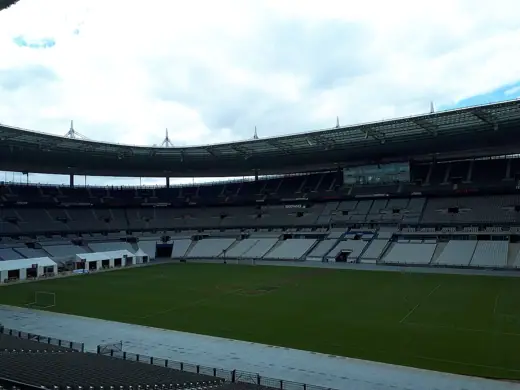
1/5 · Interior · Stade de France tourPhoto: Daniel from Glasgow, United Kingdom · CC BY 2.0 · source2/5 · Exterior · Piscine olympique de Saint-Denis en travaux : Stade de France, passerelle et piscine olympique de Saint-DenisPhoto: Claude villetaneuse · CC BY-SA 4.0 · source3/5 · Exterior · Stade de France @ Saint-DenisPhoto: Guilhem Vellut from Paris, France · CC BY 2.0 · source4/5 · InteriorPhoto: Daniel from Glasgow, United Kingdom · CC BY 2.0 · source5/5 · SectionPhoto: Passion-tango · CC BY-SA 4.0 · source
Key featuresElliptical roof of about six hectares and 13,000 t; a movable stand retracts to uncover the athletics track.
About the building
The national stadium, Stade de France, stands in Saint-Denis, north of Paris; its 81,338 seats make it France's largest. It was built for the 1998 World Cup and named at the suggestion of Michel Platini, the organising committee's head; with only 31 months allowed, work began on 2 May 1995. A France–Spain friendly opened it on 28 January 1998, and on 12 July the hosts beat Brazil 3–0 there in the final. The design, credited to Michel Macary, Aymeric Zublena, Michel Regembal and Claude Constantini, draws on Pan Am's Worldport at New York's JFK airport. It was designed to shelter 80,000 spectators without covering the pitch, and tinted glass at the centre passes the blue and green light the grass needs. To uncover the athletics track, rear sections drop 7.1 metres and inner sections retract 15 metres into the gap.
Stade de France (French pronunciation: [stad də fʁɑ̃s], lit. 'Stadium of France') is the national stadium of France, located just north of Paris in the commune of Saint-Denis. Its seating capacity of 81,338 makes it the largest stadium in France. The stadium is used by the French national football team and rugby union teams for international competitions. It is the largest in Europe for athletics events, seating 77,083 in that configuration. During other events, the stadium's running track is mostly hidden under the grandstands.
Stade de France has a movable stand which can be retracted to uncover part of the athletics track. The stadium was notably designed with the assistance of a software simulation of crowd in order to get an accurate observation of how it would look fully developed. The facility was also intended to draw interest in and develop the area of the Plaine Saint-Denis, which straddles the communes of Saint-Denis, Aubervilliers, and Saint-Ouen. The primary goal was to renovate the area by building new residential and tertiary sites.
The stadium was built without any undersoil heating as noted when Ireland were due to play France in the Six Nations Tournament rugby union match of 2012, when the game had to be canceled.