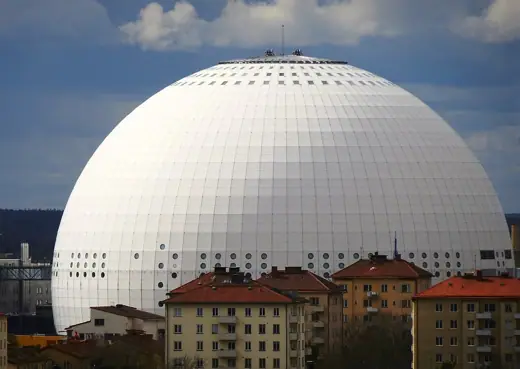
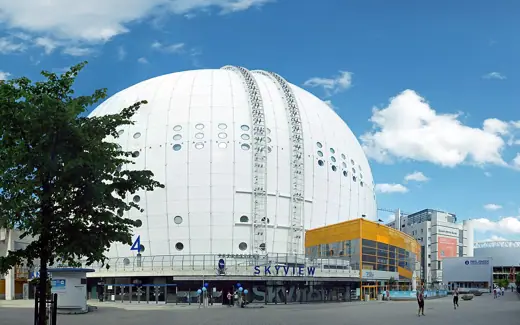
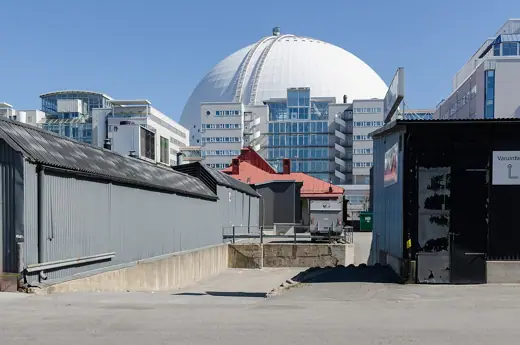
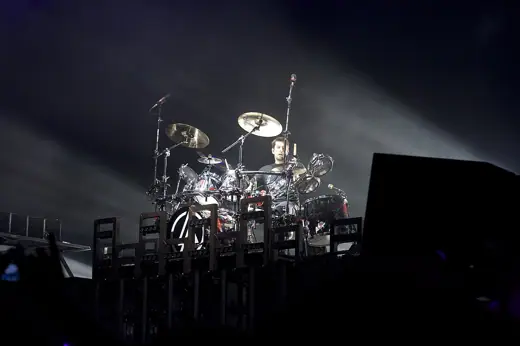
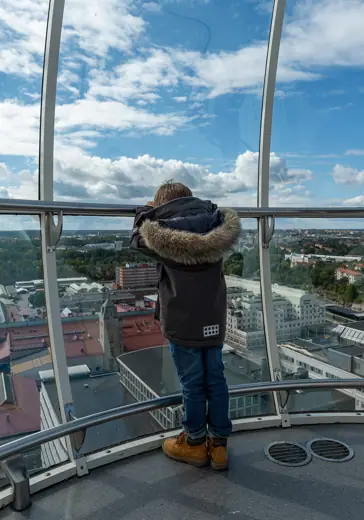
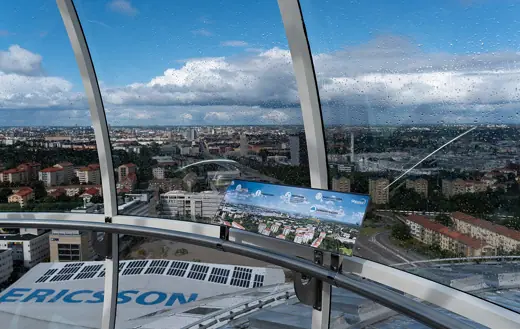
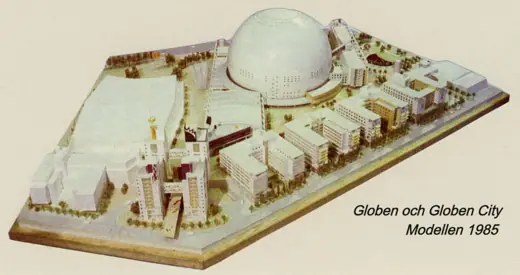
1/7 · Exterior · Globen från Hammarbybacken/toppenPhoto: Holger.Ellgaard · CC BY-SA 4.0 · source2/7 · Exterior · Globen, Stockholm, SwedenPhoto: kallerna · CC BY-SA 3.0 · source3/7 · Exterior · Ericsson Globe see from SlakthusområdetPhoto: Arild Vågen · CC BY-SA 3.0 · source4/7 · Exterior · Rob Bourdon of Linkin Park at The Globe Arena in StockholmPhoto: Rickard Laurin · CC BY-SA 3.0 · source5/7 · Detail · Gabriel enjoying the view from Globen (Skyview), Stockholm, SwedenPhoto: Jules Verne Times Two · CC BY-SA 4.0 · source6/7 · Detail · View from Globen (Skyview), Stockholm, SwedenPhoto: Jules Verne Times Two · CC BY-SA 4.0 · source7/7 · Model · Globen och Globen City, modellenPhoto: Holger.Ellgaard · CC BY-SA 3.0 · source
Culture & sport · Late modernism
Avicii Arena (Globen)
Berg Arkitektkontor · Stockholm, SE · 1989
Key featuresSpherical arena on a steel lattice frame, the largest hemispherical building in the world.
Avicii Arena is a multi-purpose arena in Stockholm Globe City, Johanneshov district of Stockholm, Sweden near the Globen metro station. The arena was previously named Stockholm Globe Arena and Ericsson Globe and is referred to in Swedish simply as Globen (Swedish: [ˈɡlǔːbɛn] ; lit. 'the Globe'), as it is shaped like a globe and represents the Sun in the Sweden Solar System, the world's largest scale model of the Solar System.
Avicii Arena is the second largest spherical building on Earth (overtaken by the Las Vegas Sphere in 2023) and took two and a half years to build. It has a diameter of 110 metres (360 ft) and an inner height of 65 metres (213 ft). The volume of the building is 605,000 cubic metres (21,400,000 cu ft) and it has a seating capacity of 16,000 spectators for shows and concerts, and 13,850 for ice hockey. In the upper area there are 40 VIP boxes and a restaurant. The building was designed by Berg Arkitektkontor AB and the globe structure was constructed by Mero-Schmidlin.




,_Stockholm,_Sweden_julesvernex2.jpg)
,_Stockholm,_Sweden_julesvernex2.jpg)
