




Palace · Historic precedent
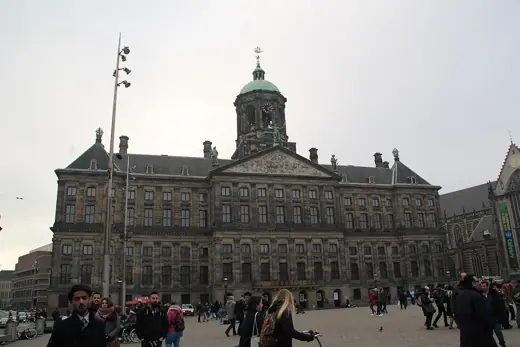
Royal Palace of Amsterdam
Key featuresBuilt as Amsterdam's city hall on 13,659 wooden piles; Van Campen took charge of the design in 1648.
About the building
The Royal Palace of Amsterdam began as the city's new town hall in the mid-1600s. Jacob van Campen, its main architect, took charge of the project in 1648, and it rests on 13,659 wooden piles. Cornelis de Graeff, the burgomaster of Amsterdam, opened the new town hall on 29 July 1655. Its yellowish sandstone has grown much darker over time, and a 6-metre statue of Atlas bearing the Globe stands astride the back of the building. Only in 1808, when the Netherlands was under Napoleon Bonaparte, did it become a royal palace, and because it was planned as a town hall it has no grand entrance, unlike most royal palaces. An Act of Parliament places it among the three Dutch palaces at the monarch's disposal. A renovation from 2005 to June 2009 included the removal of asbestos.
Sources: Royal Palace of Amsterdam · Jacob van Campen (Wikipedia)
More with monumentalityAll 909 →


Find more with
Monumentality909 buildings →Axis319 buildings →Detail553 buildings →Palace44 buildings →Each opens every building that shares the idea.
Details
- Architect
- Jacob van Campen
- Place
- Amsterdam, Netherlands
- Year
- 1655
- Typology
- Palace
- Movement
- Historic precedent
- Region
- Europe

Go deeper





More · PalaceAll 44 →


Portrait: Unknown author · Attribution · source