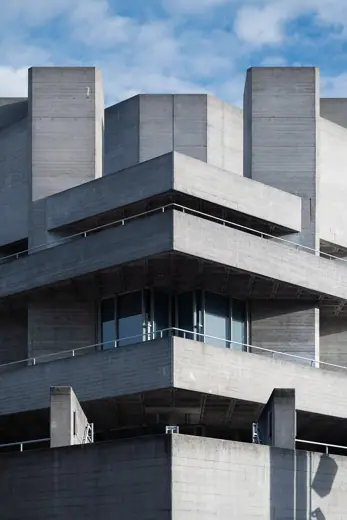
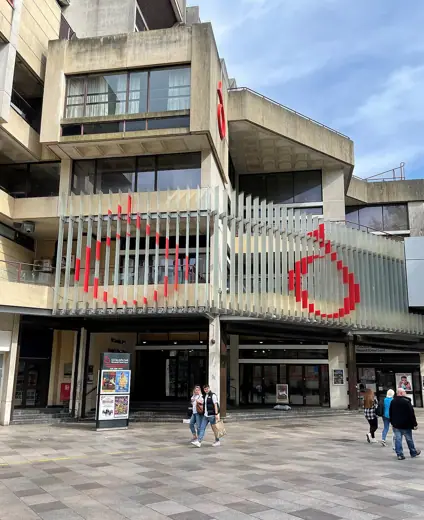
1/7 · ExteriorPhoto: Julian Herzog ( Website ) · CC BY 4.0 · source2/7 · ExteriorPhoto: Julian Herzog ( Website ) · CC BY 4.0 · source3/7 · Exterior · Entrance to The National TheatrePhoto: Neil Theasby · CC BY-SA 2.0 · source4/7 · ExteriorPhoto: Tom Parnell · CC BY-SA 4.0 · source5/7 · Interior · Bar at the Royal National TheatrePhoto: Anthony O'Neil · CC BY-SA 2.0 · source6/7 · Interior · Waiting for the start of Earthquakes in London at the Cottesloe, National Theatre, LondonPhoto: Tony Hisgett from Birmingham, UK · CC BY 2.0 · source7/7 · InteriorPhoto: Txllxt TxllxT · CC BY-SA 4.0 · source
Key featuresBoard-marked concrete terraces step toward the Thames, linking three auditoria through open foyers.
About the building
The Royal National Theatre on London's South Bank is Denys Lasdun's best-known work and among the most notable Brutalist buildings in Britain. It holds three theatres. The main auditorium, named after the company's first artistic director Laurence Olivier, is modelled on the ancient theatre at Epidaurus, with an open stage and 1,160 seats in a fan. The main material is a pale concrete chosen to suit the stone of Somerset House and Waterloo Bridge. Cast in rough timber formwork, it keeps the board grain on surfaces inside and out. On its opening, the historian Mark Girouard called the style "an aesthetic of broken forms". In 1988 the future Charles III described it as a clever way to put a nuclear power station in central London without anyone objecting. Despite such controversy, it has been Grade II* listed since 1994.
The National Theatre (NT), officially the Royal National Theatre since 1988 and sometimes referred to as the National Theatre of Great Britain, is a performing arts venue and associated theatre company located in London, England, adjacent to (but not part of) the Southbank Centre. The theatre was founded by Laurence Olivier in 1963 and many well-known actors have since performed with it.
The style of the National Theatre building was described by architecture historian Mark Girouard as "an aesthetic of broken forms" at the time of opening. Architectural opinion was split at the time of construction. Even enthusiastic advocates of the Modern Movement such as Nikolaus Pevsner found the Béton brut RAAC concrete both inside and out overbearing. Most notoriously, the future Charles III described the building in 1988 as "a clever way of building a nuclear power station in the middle of London without anyone objecting". John Betjeman, a man not noted for his enthusiasm for brutalist architecture, wrote to Lasdun stating ironically that he "gasped with delight at the cube of your theatre in the pale blue sky and a glimpse of St Paul's to the south of it. It is a lovely work and so good from so many angles...it has that inevitable and finished look that great work does."