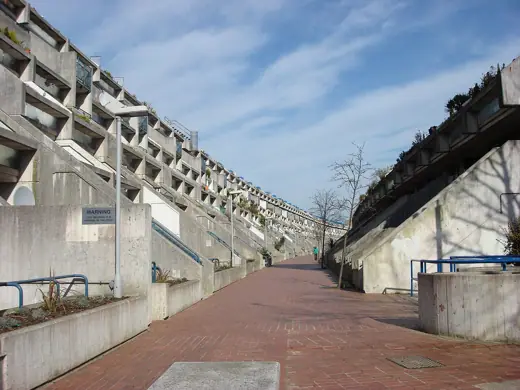
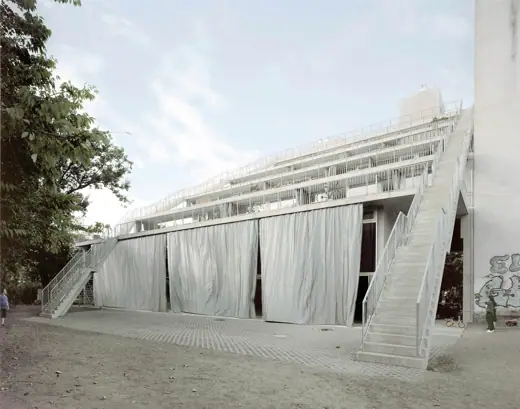
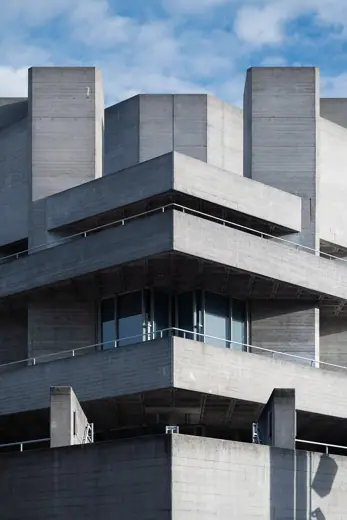
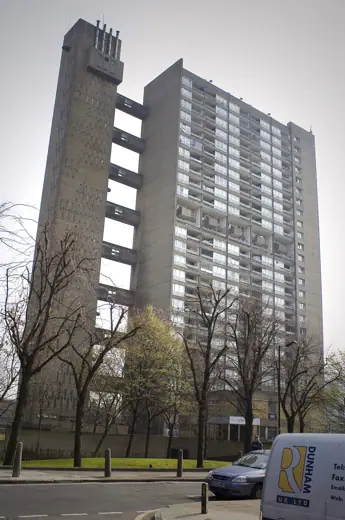
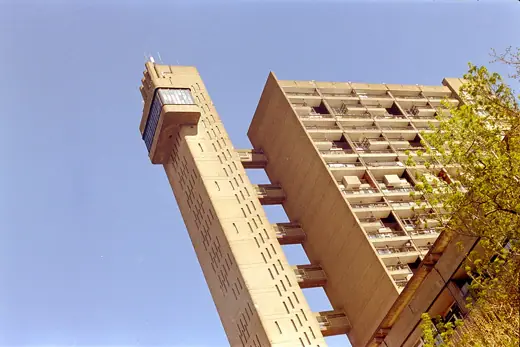
1/6 · Exterior · Rowley Way, Alexandra and Ainsworth Estate, Camden, LondonPhoto: Oxyman · CC BY 2.5 · source2/6 · Exterior · Processed with VSCO with al3 preset aka Alexandra Road EstatePhoto: Scott Wylie from UK · CC BY 2.0 · source3/6 · ExteriorPhoto: Scott Wylie · CC BY 2.0 · source4/6 · ExteriorPhoto: Jonframe1 · CC BY-SA 4.0 · source5/6 · Detail · Alexandra & Ainsworth Estate, NW6 - outdoor seating areaPhoto: Sludge G · CC BY-SA 4.0 · source6/6 · ContextPhoto: Jonframe1 · CC BY-SA 4.0 · source
Key featuresStepped concrete terraces line a pedestrian street, shielding the homes from the railway behind.
About the building
Often called Rowley Way, the Alexandra Road Estate is a housing estate in Camden, London. Neave Brown of the council's architects department designed it in 1968 in a brutalist manner, using reinforced concrete cast on site, board-marked, white and unpainted. Three parallel east–west blocks fill a crescent-shaped site with the West Coast Main Line to the north, and controlling train noise and vibration was a major factor in the layout. The eight-storey block beside the railway is a ziggurat that serves as a sound barrier, on foundations set on rubber pads that remove vibration. Its stepped elevation gives each home a private outdoor space on a flat roof. A school, a community centre and parkland sit alongside the 520 flats. In 1993 it became the first post-war council estate to be listed, at Grade II*.
The Alexandra Road Estate (officially the Alexandra and Ainsworth Estate, but often referred to as Rowley Way, the name of its main thoroughfare) is a housing estate in the London Borough of Camden, North London, England. It was designed in a brutalist style in 1968 by Neave Brown of Camden Council's Architects Department. Construction work commenced in 1972 and was completed in 1978. It is constructed from site-cast, board-marked, white, unpainted reinforced concrete. Along with 520 apartments, the site also includes a school, community centre, youth club, heating complex, tenants hall, and parkland. Views of the construction of the development are shown in the 1970s TV detective drama series The Sweeney (Series 3, Episode 9, 1976).