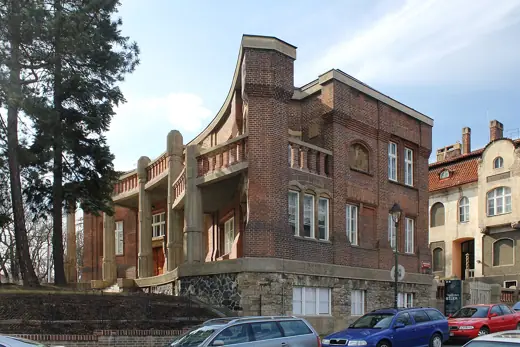
1/7 · Context · The Red House in Upton, Bexleyheath , Greater LondonPhoto: Ethan Doyle White · CC BY-SA 3.0 · source2/7 · Exterior · London: RED HOUSE, RED HOUSE LANE, E side BexleyPhoto: Tilman2007 · CC BY-SA 4.0 · source3/7 · Exterior · The home of William MorrisPhoto: Tony Hisgett from Birmingham, UK · CC BY 2.0 · source4/7 · Interior · London: RED HOUSE, RED HOUSE LANE, interior, first floor BexleyPhoto: Tilman2007 · CC BY-SA 4.0 · source5/7 · Detail · Red House, BexleyheathPhoto: k7hpn · CC BY 4.0 · source6/7 · Model · Casa Vicens (Barcelona), maqueta de la Red House, Londres, de PhPhoto: Enric · CC BY-SA 4.0 · sourcePhotos unavailable7/7Ethan Doyle White · CC BY-SA 3.0 · source
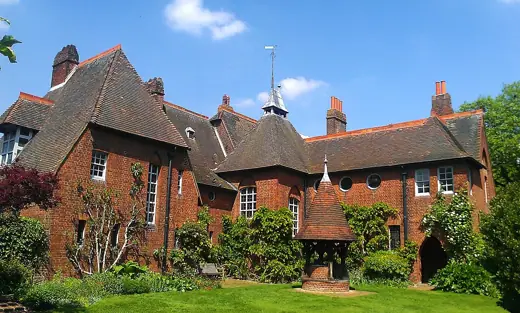
Key featuresL-shaped plan with a high-pitched red tile roof; windows placed to suit the rooms, not symmetry.
About the building
Philip Webb, an architect, and William Morris, a designer, worked out Red House together in 1859 as Morris's family home; it was finished in 1860. It was Webb's first independent commission, and Morris never built another house. Built on Morris's ideals of craft and artisan skill, it is an early instance of what was later called the Arts and Crafts movement. The plan is an L of two storeys under a steep red-tiled roof. Windows were placed to suit each room, not to make the outside symmetrical, so many types sit side by side, from tall casements to bull's-eye windows. There is no applied ornament; arches over windows and other decoration come from construction itself. Morris wanted house and garden designed as one; rose trellises split the garden into four squares. It was listed at Grade I in 1950.
Portrait: Charles Fairfax Murray · Public domain · source
About Red House
Red House is a significant Arts and Crafts building located in Bexleyheath, south-east London, England. Co-designed in 1859 by the architect Philip Webb and the designer William Morris, it was created to serve as a family home for Morris. Construction was completed in 1860.
Following an education at the University of Oxford, Morris decided to construct a rural house for himself and his new wife, Jane Morris, within a commuting distance of central London. Purchasing a plot of land in what at the time was the village of Upton in Kent, he employed his friend Webb to help him design and construct the house, financing the project with money inherited from his wealthy family. Morris was deeply influenced by medievalism and medieval-inspired neo-Gothic styles are reflected throughout the building's design, which he described as being "very medieval in spirit." It was constructed using Morris' ethos of craftsmanship and artisan skills and is an early example of what came to be known as the Arts and Crafts movement.