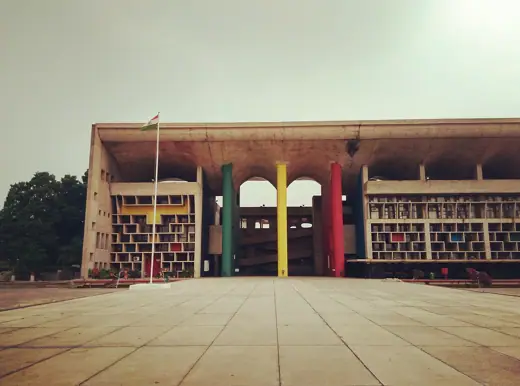
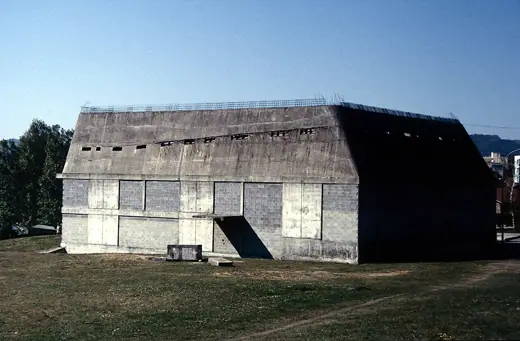
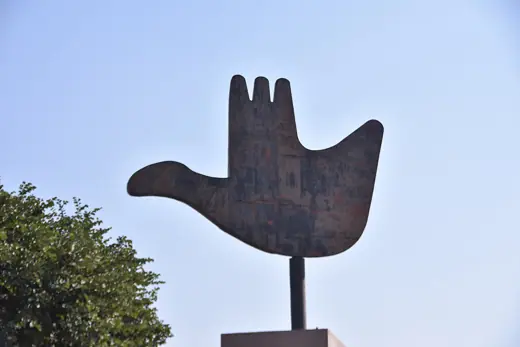
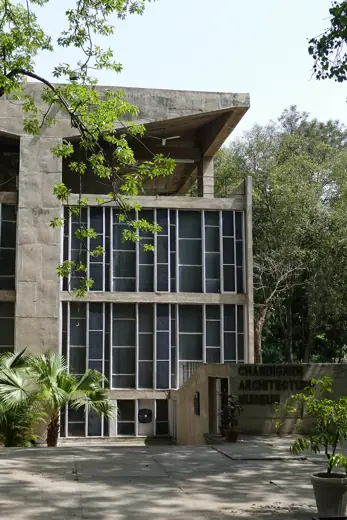
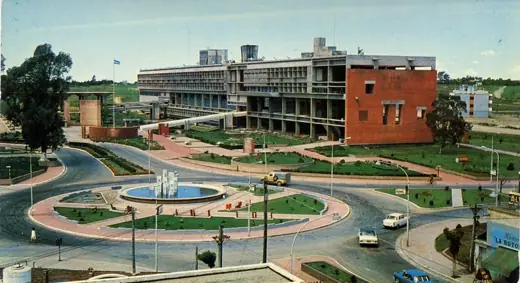
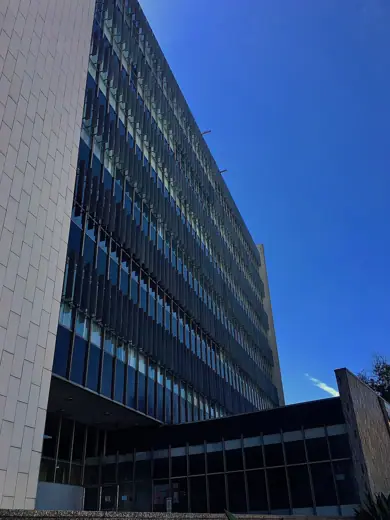
1/7 · ExteriorPhoto: Nk8595 · CC BY-SA 4.0 · source2/7 · Exterior · High Court building of Hariyana and PunjabPhoto: Shanmugamp7 · CC BY-SA 3.0 · source3/7 · ExteriorPhoto: Nk8595 · CC BY-SA 4.0 · source4/7 · Exterior · High Court of Punjab & Haryana, Chandigarh by Le CorbusierPhoto: Aleksandr Zykov from Russia · CC BY-SA 2.0 · source5/7 · InteriorPhoto: Nicholas.iyadurai · CC BY-SA 4.0 · source6/7 · InteriorPhoto: Nicholas.iyadurai · CC BY-SA 4.0 · source7/7 · ModelPhoto: 丘崈 · CC0 · source
Key featuresA huge concrete parasol roof shades the courts, with colossal coloured pylons framing the entrance.
About the building
The Palace of Justice in Chandigarh is the building of the Punjab and Haryana High Court, the court shared by Punjab, Haryana and Chandigarh, a Union Territory. Le Corbusier, author of Chandigarh's master plan, was picked to carry out the court building as well. Jawaharlal Nehru, India's first Prime Minister, backed the project with enthusiasm and followed its progress closely. The court moved to its present home in Chandigarh on 17 January 1955. In July 2016 the building was inscribed as a UNESCO World Heritage Site together with other works by Le Corbusier, in a listing of seventeen of his projects in seven countries titled The Architectural Work of Le Corbusier, an Outstanding Contribution to the Modern Movement.
Portrait: Joop van Bilsen for Anefo · CC0 · source
About Palace of Justice (Punjab and Haryana High Court)
Punjab and Haryana High Court is the common High Court for the Indian states of Punjab and Haryana and the Union Territory of Chandigarh based in Chandigarh, India. Sanctioned strength of judges of this High Court is 85, consisting of 64 Permanent Judges, including the Chief Justice, and 21 Additional Judges. As of 21 August 2026, there are 64 Judges working in the High Court, comprising 41 Permanent and 23 Additional Judges.
The court building is known as the Palace of Justice. Designed by Le Corbusier, it and several of his other works were inscribed as UNESCO World Heritage Sites in July 2016.
Sarv Mittra Sikri, who had been practising in the High Court of Punjab and Haryana and remained Advocate-General for Punjab from 1 November 1956 to 2 February 1964, was the first to be appointed as judge of the Supreme Court of India on 3 February 1964 directly from the Bar; later, becoming the Chief Justice of India on 22 January 1971, again with the distinction of being first of only two CJIs directly from the Bar.
Past judges include Madan Mohan Punchhi, P. Sathasivam, Tirath Singh Thakur, Jagdish Singh Khehar, Ranjan Gogoi and Surya Kant who were elevated to the Supreme Court of India and became Chief Justice of India.