
Memorial · Historic precedent
Humayun's Tomb
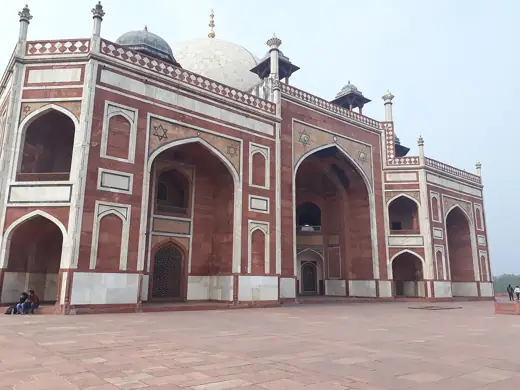
Key featuresDouble dome on a high drum; red sandstone with white marble, the first such combination at this scale in India.
About the building
Empress Bega Begum, Humayun's chief consort, commissioned this tomb in 1558 and paid its whole cost of 1.5 million rupees. She chose its Persian designers herself: Mirak Mirza Ghiyas and his son, Sayyid Muhammad. Built from 1565 to 1572 in Delhi, it was the subcontinent's first garden-tomb, at the heart of a 30-acre Persian-style charbagh. Its model was Gur-e Amir in Samarkand, the tomb of Humayun's ancestor Timur. Its rubble and red sandstone are faced in white marble, also used for the jaali screens and main dome. Rising 47 m, it was the first building in India with a Persian double dome on a tall drum. Inside a plain exterior, eight two-storey vaulted rooms ring a domed central chamber. It set the pattern for Mughal royal tombs up to the Taj Mahal, and became a World Heritage Site in 1993.
Sources: Humayun's tomb (Wikipedia)
More with stoneAll 524 →


Find more with
Stone524 buildings →Geometry1061 buildings →Axis319 buildings →Memorial119 buildings →Each opens every building that shares the idea.
Details
- Architect
- Mirak Mirza Ghiyas and Sayyid Muhammad
- Place
- New Delhi, India
- Year
- 1572
- Typology
- Memorial
- Movement
- Historic precedent
- Region
- South Asia