

Memorial · Historic precedent
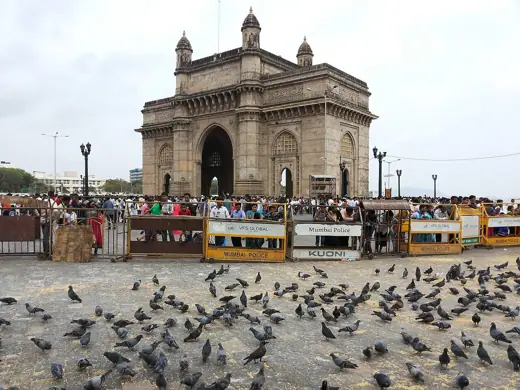
Gateway of India
Key features26 m yellow basalt and reinforced-concrete arch, Indo-Saracenic, drawing on 16th-century Gujarati architecture.
About the building
This arch on Mumbai's waterfront marks the landing of King George V in December 1911, when he came to be crowned Emperor of India; no British monarch had visited India before him. Its foundation stone dates from March 1913, but George Wittet's final design was approved only in 1914, and work ended in 1924. Its Indo-Saracenic style draws on 16th-century Gujarati architecture, and the façade recalls Gujarati mosques such as Ahmedabad's Jama Mosque. In plan it is an octopylon, set on eight piers. The arch rises 26 m, under a central dome 15 m across, and is built of local yellow basalt and reinforced concrete. For lack of funds the approach road was never built, so the Gateway sits askew to the road reaching it. In February 1948 the last departing British troops marched through it to a 21-gun salute.
Sources: Gateway of India (Wikipedia)
More by George WittetAll 3 →
More with stoneAll 524 →


Find more with
Stone524 buildings →Axis319 buildings →Monumentality909 buildings →Memorial119 buildings →Each opens every building that shares the idea.
Details
- Architect
- George Wittet
- Place
- Mumbai, India
- Year
- 1924
- Typology
- Memorial
- Movement
- Historic precedent
- Region
- South Asia