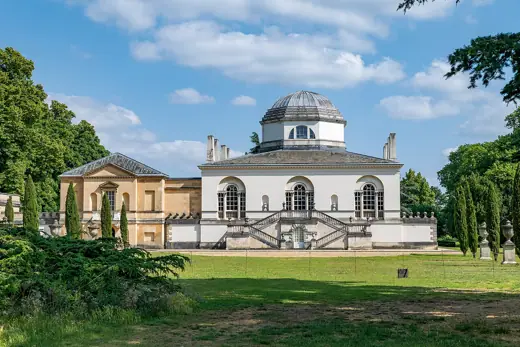
1/6 · Exterior · London: CHISWICK HOUSE HounslowPhoto: Tilman2007 · CC BY-SA 4.0 · source2/6 · Exterior · London: CHISWICK HOUSE HounslowPhoto: Tilman2007 · CC BY-SA 4.0 · source3/6 · InteriorPhoto: Tom P from Scottish Borders, Scotland · CC BY-SA 2.0 · source4/6 · Interior · LondonPhoto: orangeaurochs · CC BY 2.0 · source5/6 · Plan · Floor plan of Chiswick with additional wingsPhoto: Chivalrick1 · CC BY-SA 3.0 · source6/6 · Elevation · Chiswick House, a Palladian villa in Burlington Lane, Chiswick, London, EnglandPhoto: DanielCahen01 · CC BY 4.0 · source
Key featuresA neo-Palladian villa with a six-column Corinthian portico and a steep-pitched dome.
About the building
Richard Boyle, 3rd Earl of Burlington, designed and built Chiswick House, a Neo-Palladian villa in the London district of Chiswick, and finished it in 1729. A journey to Italy in 1719 had given him a passion for Palladian architecture. He made the villa big enough for his art collection, said to hold 'some of the best pictures in Europe', and for his best furniture. Before it, a Jacobean house stood on the site. William Kent, an architect and landscape designer, did most of the work on the garden, which is among the first English landscape gardens. The house went downhill in the 19th century, and the Cavendish family rented it out. It is now listed at Grade I and looked after by English Heritage.
Portrait: Jonathan Richardson · Public domain · source
About Chiswick House
Chiswick House is a Neo-Palladian style villa in the Chiswick district of London, England. A "glorious" example of Neo-Palladian architecture in west London, the house was designed and built by Richard Boyle, 3rd Earl of Burlington (1694–1753), and completed in 1729. The house and garden occupy 26.33 hectares (65.1 acres). The garden was created mainly by the architect and landscape designer William Kent, and it is one of the earliest examples of the English landscape garden.
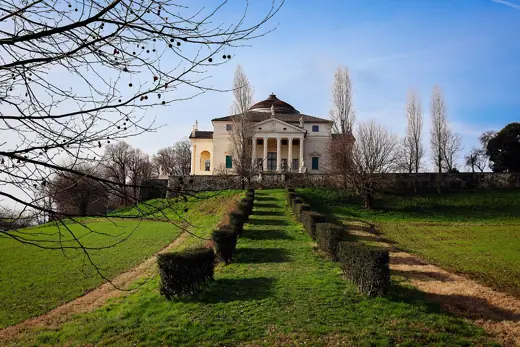
Chiswick House was an attempt by Lord Burlington to create a Roman villa, rather than a Renaissance pastiche, situated in a symbolic Roman garden. Chiswick Villa is inspired in part by several buildings of the 16th-century Italian architects Andrea Palladio and his assistant Vincenzo Scamozzi. The house is often said to be directly inspired by Palladio's Villa Capra "La Rotonda" near Vicenza, as architect Colen Campbell had offered Lord Burlington a design for a villa closely based on the Villa Capra for his use at Chiswick. However, although this was clearly influential, Lord Burlington rejected this design; it was subsequently used at Mereworth Castle, Kent.