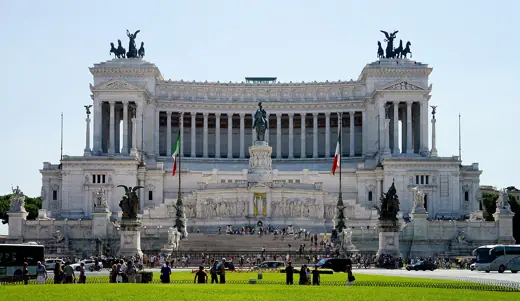
1/7 · Exterior · The Altare della Patria, a monument to Vittorio Emanuele II, RomePhoto: Alvesgaspar · CC BY-SA 4.0 · source2/7 · ExteriorPhoto: Julian Lupyan · CC0 · source3/7 · Exterior · Monument to Victor Emmanuel II, Rome, ItalyPhoto: Diego Delso · CC BY-SA 4.0 · source4/7 · Exterior · Monument to Victor Emmanuel II, Rome, ItalyPhoto: Diego Delso · CC BY-SA 4.0 · source5/7 · InteriorPhoto: Darafsh · CC BY-SA 3.0 · source6/7 · InteriorPhoto: Darafsh · CC BY-SA 3.0 · source7/7 · Plan · Map of the Monument to Vittorio Emanuele IIPhoto: Mazeppa · CC BY-SA 3.0 · source
The Victor Emmanuel II National Monument (Italian: Monumento Nazionale a Vittorio Emanuele II), also known as the Vittoriano or for synecdoche Altare della Patria ("Altar of the Fatherland"), is a large national monument built between 1885 and 1935 to honour Victor Emmanuel II, the first king of a unified Italy, in Rome, Italy. It occupies a site between the Piazza Venezia and the Capitoline Hill. The monument was realized by Giuseppe Sacconi.
From an architectural perspective, it was conceived as a modern forum, an agora on three levels connected by stairways and dominated by a portico characterized by a colonnade. The complex process of national unity and liberation from foreign domination carried out by King Victor Emmanuel II of Savoy, to whom the monument is dedicated, has a great symbolic and representative value, being architecturally and artistically centred on the unification of Italy—for this reason the Vittoriano is considered one of the national symbols of Italy.