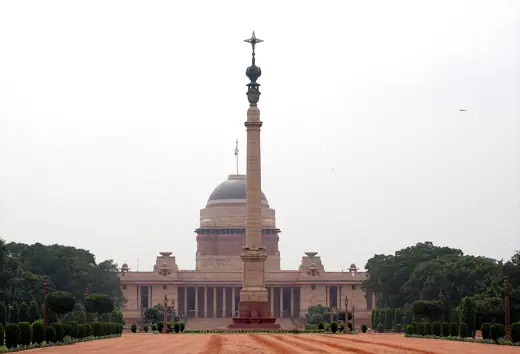
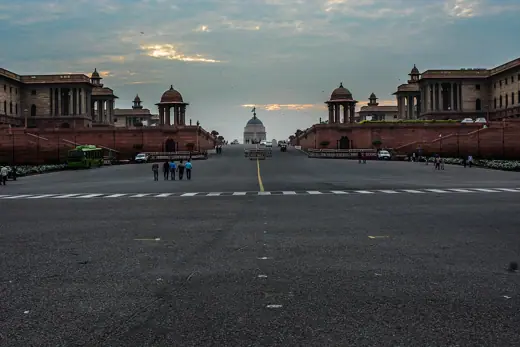
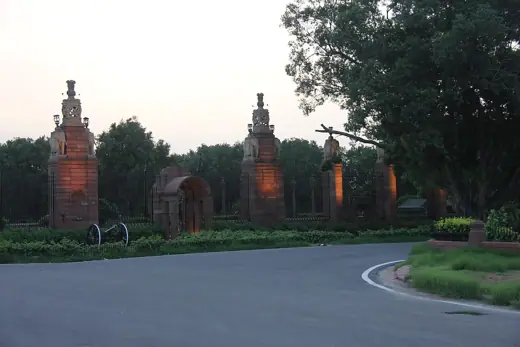
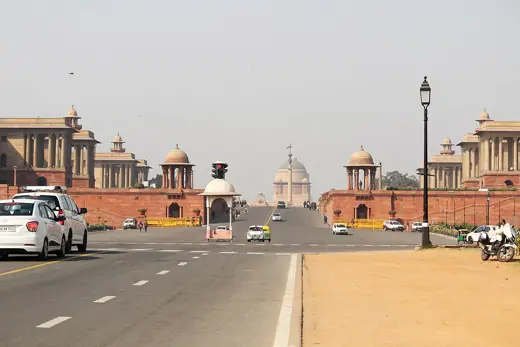
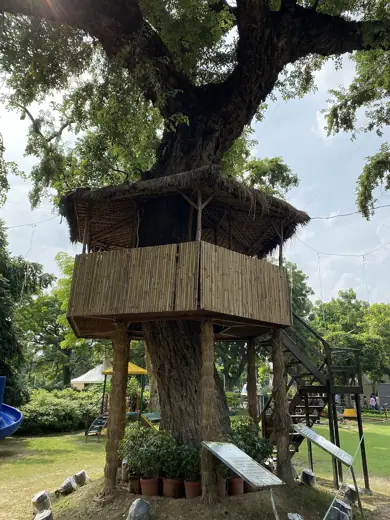
1/6 · Detail · Rashtrapati Bhavan, the presidential palace in New Delhi, IndiaPhoto: This image was produced by me, David Castor ( user:dcastor ). The pictures I submit to the Wikipedia · Public domain · source2/6 · Exterior · This is a photo of ASI monument numberPhoto: J.srivastava44 · CC BY-SA 4.0 · source3/6 · Exterior · Rashtrapati Bhavan, Delhi side wallPhoto: AKS.9955 · CC BY-SA 4.0 · source4/6 · Exterior · This is a photo of ASI monument numberPhoto: Yamik Suthar · CC BY-SA 4.0 · source5/6 · Interior · A 225 year old tree inside Rashtrapati BhavanPhoto: Tamjeed Ahmed · CC BY-SA 4.0 · source6/6 · InteriorPhoto: No Swan So Fine · CC BY-SA 4.0 · source
Palace · Historic precedent
Rashtrapati Bhavan
Edwin Lutyens · New Delhi, India · 1929
Key featuresClassical plan fused with Indian motifs: a stupa-like dome, chhatris and deep chhajja sunshades.
The Rashtrapati Bhavan (, ISO: Rāṣṭrapati Bhavana; lit. 'President's House'), formerly Viceroy's House (1931–1947) and Government House (1947–1950) is the official residence of the President of India, located at the western end of Rajpath, Raisina Hill in New Delhi.
The building was designed by Edwin Lutyens and Herbert Baker in Delhi Order based on Indo-Saracenic architecture. The construction began in 1912 and the building was completed in 1929. The building, initially known as Viceroy's House, housed the Viceroy of India from 1931 until India's independence. After Independence, it briefly served as the Government House, housing the Governor General of India from 1947 to 1950. When India became a Republic, it became the official residence of the President of India and was renamed as the Rashtrapati Bhavan.



.jpg)

.jpg)

