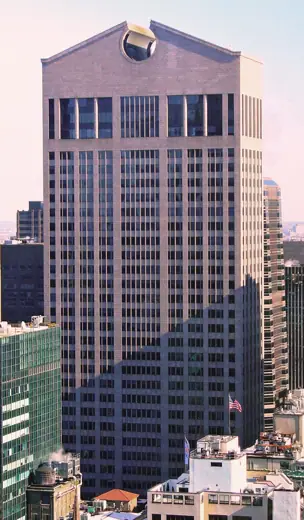
1/6 · Exterior · Sony Building New YorkPhoto: David Shankbone ; cropped by Beyond My Ken ( talk ) 13:28, 30 January 2011 (UTC) · CC BY 2.5 · source2/6 · Exterior · 550 Madison Avenue in Manhattan, New York, seen in May 2022Photo: Epicgenius · CC BY-SA 4.0 · source3/6 · ExteriorPhoto: Citizen59 · CC BY 3.0 · source4/6 · Exterior · Skyscrapers - New York, NY, USA - August 18, 2015Photo: Giorgio Galeotti · CC BY 3.0 · source5/6 · Interior · 550 Madison Avenue in Manhattan, New York, seen in December 2022Photo: Epicgenius · CC BY-SA 4.0 · source6/6 · Interior · 550 Madison Avenue in Manhattan, New York, seen in December 2022Photo: Epicgenius · CC BY-SA 4.0 · source
Portrait: B. Pietro Filardo · CC BY-SA 3.0 · source
About AT&T Building (550 Madison Avenue)
550 Madison Avenue (also 550 Madison; formerly known as the Sony Tower, Sony Plaza, and AT&T Building) is a postmodern–style skyscraper on Madison Avenue between 55th and 56th Streets in the Midtown Manhattan neighborhood of New York City, New York, U.S. Designed by Philip Johnson and John Burgee with associate architect Simmons Architects, the building is a 647-foot-tall (197-meter), 37-story office tower with a facade made of pink granite. It was completed in 1984 as the headquarters of AT&T Corp. and later became the American headquarters of Sony. A four-story granite annex to the west was demolished and replaced with a shorter annex in the early 2020s.
550 Madison Avenue was designed by Philip Johnson and John Burgee of Johnson/Burgee Architects. Johnson had been an influential figure in modernist architecture during the late 20th century, having helped design the Seagram Building nearby in the 1950s, but he reverted to more classical motifs for 550 Madison Avenue's design. The building was among Johnson and Burgee's most influential works and, according to the New York City Landmarks Preservation Commission (LPC), is sometimes described as the world's first postmodern–style skyscraper. Alan Ritchie of Johnson/Burgee was named as design manager, while Simmons Architects was the associate architect.