

Civic · Historic precedent
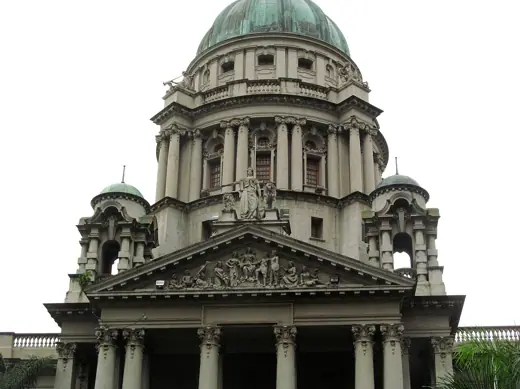
Cape Town City Hall
Key featuresEdwardian city hall of honey-coloured limestone imported from Bath, with a clock tower and carillon.
About the building
This large Edwardian city hall of 1905 stands in central Cape Town, on the Grand Parade, with the Castle to its east. It is built of honey-coloured oolitic limestone brought from Bath in England, and much of its other material, fixtures and fittings included, also came from Europe. A city hall was first suggested in 1887, around Queen Victoria's Golden Jubilee, as a tribute. In 1893, after the council had approved a scheme, H S Greaves, chief architect of Public Works, judged an open competition. The architects Harry Austin Reid and Frederick George Green won it, with T. Howard and F. G. Scott as builders. A turret clock in the tower strikes the hours and plays the Westminster quarters, and the carillon, with 22 added bells, was installed as a First World War memorial.
Sources: Cape Town City Hall (Wikipedia)
More with stoneAll 524 →


Find more with
Stone524 buildings →Monumentality909 buildings →Public space617 buildings →Civic375 buildings →Each opens every building that shares the idea.
Details
- Architect
- Henry Austin Reid and Frederick George Green
- Place
- Cape Town, South Africa
- Year
- 1905
- Typology
- Civic
- Movement
- Historic precedent
- Region
- Africa