




Infrastructure · Contemporary
Alamillo Bridge

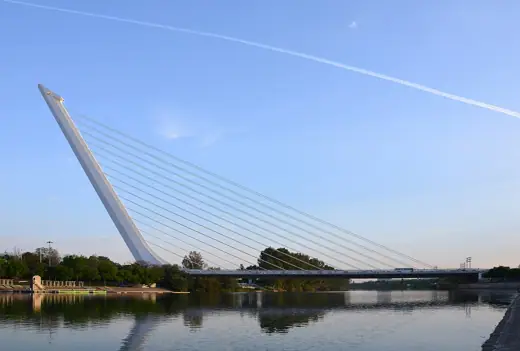
Key featuresA single leaning pylon, 142 m tall, balances the deck with its own weight, with no back-stay cables.
About the building
Santiago Calatrava designed the Alamillo Bridge in Seville, built between 1989 and 1992. Its structural idea goes back to his 1986 sculpture 'Running Torso', where tilted stacked marble cubes are held in balance by a taut wire. A single straight tower of steel shell, filled with reinforced concrete, leans backward and balances a 200 m span through thirteen pairs of cables. Because the tower is heavy enough to offset the deck, no back stays are needed; its weight does the job of one set of stay cables. Steel wings cantilever from a hexagonal spine to carry three traffic lanes each side, and the spine's top, lifted 1.6 metres (5 feet) above the road, forms a footway and cycle lane between them. A stairway inside the tower climbs to a lookout at its top.
Sources: Alamillo Bridge (Wikipedia)
More by Santiago CalatravaAll 26 →
More with structure as expressionAll 668 →

Find more with
Structure as expression668 buildings →Tensile structure58 buildings →Cantilever180 buildings →Infrastructure223 buildings →Each opens every building that shares the idea.
Details
- Place
- Seville, Spain
- Year
- 1992
- Typology
- Infrastructure
- Movement
- Contemporary
- Region
- Europe
Go deeper




See all 9 links


More · InfrastructureAll 223 →

Portrait: Wilson Center · CC BY-SA 3.0 · source