




Museum · High-tech
Museum of Tomorrow

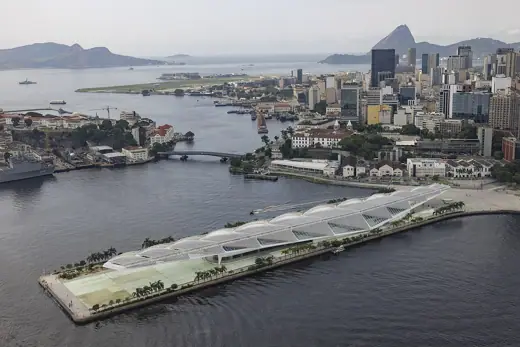
Key featuresLong cantilevered roof with moving solar fins, cooled with water drawn from the bay.
About the building
Santiago Calatrava, the Spanish neofuturist architect, designed the Museum of Tomorrow on the waterfront at Pier Maua in Rio de Janeiro. It occupies a 7,600-square-metre harbourside plaza, ringed by reflecting pools, and President Dilma Rousseff attended its opening on 17 December 2015. Calatrava wrote that the building should feel ethereal and seem almost to float on the water, evoking a ship, bird or plant. Movable screens on the roof respond to the sun's path. Seawater helps control the indoor temperature and tops up the pools. The museum was presented as a symbol of the port area's reurbanisation. Its main exhibition guides visitors through experiments and experiences in five areas: Cosmos, Earth, Anthropocene, Tomorrow, and finally Us.
Sources: Museum of Tomorrow · Santiago Calatrava (Wikipedia)
More by Santiago CalatravaAll 26 →
More with climate responseAll 258 →
Find more with
Climate response258 buildings →Structure as expression668 buildings →Water306 buildings →Museum735 buildings →Each opens every building that shares the idea.
Details
Go deeper




See all 9 links


More · MuseumAll 735 →
Portrait: Wilson Center · CC BY-SA 3.0 · source