




Culture & sport · Late modernism
Yoyogi National Gymnasium

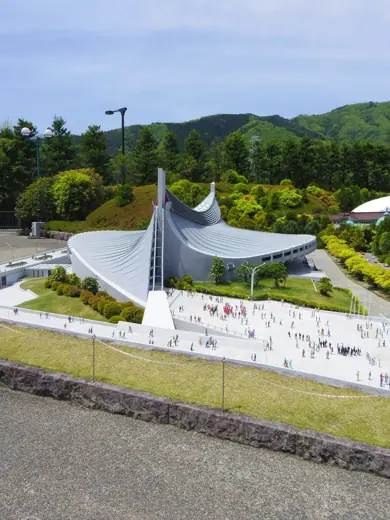
Key featuresA suspension roof hung from two concrete masts, built for the 1964 Olympics.
About the building
Kenzō Tange began designing Yoyogi National Gymnasium in 1961 with the engineer Yoshikatsu Tsuboi, for the 1964 Summer Olympics in Tokyo. Approval of the bid came 20 months before the games, construction took 18 months, and the building opened on October 10, 1964. When built, it had the largest suspended roof span in the world: two reinforced concrete pillars hold a pre-stressed steel net with steel plates fixed onto it. The roof's overall curve helps shield the building from strong winds. It inspired the design of Munich's Olympic Stadium for the 1972 games, and when Tange won the Pritzker Architecture Prize in 1987 the citation counted it "among the most beautiful buildings of the 20th century". In 2021 Japan made it an Important Cultural Property, calling it a monumental postwar work with an energetic exterior and grand interior.
Sources: Yoyogi National Stadium · Kenzō Tange (Wikipedia)
More by Kenzō TangeAll 24 →

More with tensile structureAll 58 →
Find more with
Tensile structure58 buildings →Structure as expression668 buildings →Sculptural form769 buildings →Culture & sport614 buildings →Each opens every building that shares the idea.
Details
- Place
- Tokyo, Japan
- Year
- 1964
- Typology
- Culture & sport
- Movement
- Late modernism
- Region
- East Asia
Go deeper




See all 9 links


More · Culture & sportAll 614 →

Portrait: Hans van Dijk for Anefo · CC BY-SA 3.0 nl · source