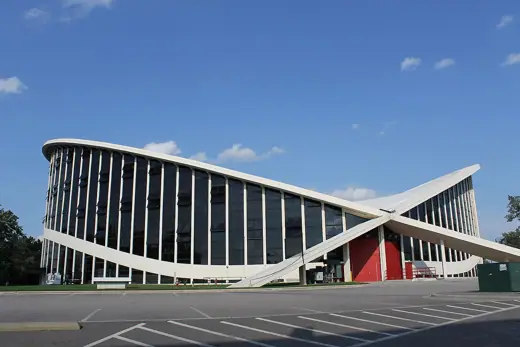
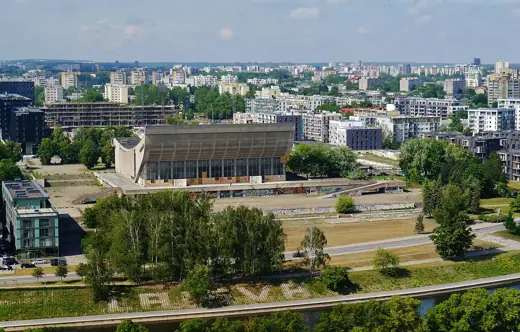
1/4 · ExteriorPhoto: Leah Rucker · CC BY-SA 3.0 · source2/4 · Exterior · Where I saw the circus some time around 1979/1980Photo: Billie Grace Ward from New York, USA · CC BY 2.0 · source3/4 · ExteriorPhoto: Leah Rucker · CC BY-SA 3.0 · source4/4 · Exterior · Dorton Arena, State Fairgrounds, Raleigh, NCPhoto: Warren LeMay from Cincinnati, OH, United States · CC0 · source
Key featuresThe first structure in the world to use a cable-supported roof.
About the building
Opened in 1952 as State Fair Arena, this 7,610-seat arena stands on the North Carolina State Fair grounds in Raleigh. Maciej Nowicki of NC State's architecture department designed it but died in a plane crash before building started; local architect William Henley Deitrick saw it through. It was the world's first structure with a cable-supported roof: a saddle of steel cables in tension, held up by parabolic concrete arches in compression. The arches cross some 26 feet up and continue underground, where further cables tie their ends, and the outer walls carry next to no weight. In 1953 it was one of just two new US buildings to win the American Institute of Architects' National Honor Award, and it inspired many architects and civil engineers in the US and abroad.
J. S. Dorton Arena is a 7,610-seat multi-purpose arena located in Raleigh, North Carolina, on the grounds of the North Carolina State Fair. It opened in 1952 as State Fair Arena. It has hosted many sporting events, concerts, political rallies, and circuses.
Dorton Arena was the first structure in the world to use a cable-supported roof. Its design features a steel cable supported saddle-shaped roof in tension, held up by parabolic concrete arches in compression. The arches cross about 26 feet above ground level and continue underground, where their ends are held together by more steel cables in tension. The outer walls of the arena support next to no weight at all.
The arena served as an inspiration to many architects and civil engineers, both at home and abroad. This led to a boom in lightweight constructions such as the Europe 1-Broadcasting House (1954) in Überherrn, the auditorium Paul-Emile Janson (1956) in Bruxelles, the Ingalls Rink (1958) in New Haven, the Športová hala Pasienky (1958) in Bratislava, the Yoyogi National Gymnasium (1964) in Tokyo, the Ice Aréna (1965) in Prešov and the Sporthal Beverwijk (1971) in Beverwijk.