

Infrastructure · Contemporary
Tokyo Skytree
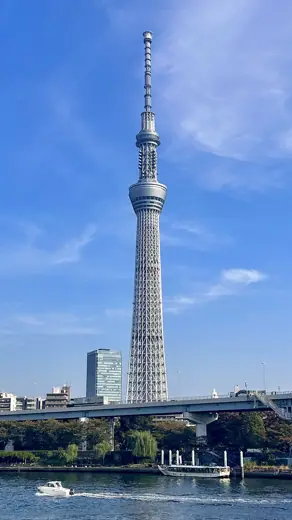
Key featuresTriangular base morphs into a round plan, with a concrete core acting as a pagoda-style damping column.
About the building
Tokyo Skytree, in Sumida, Tokyo, serves both as a broadcasting tower and an observation tower, with Nikken Sekkei as lead architects. As of 2019 it was described as the world's tallest self-supporting broadcasting tower and the second tallest structure of any kind made by people. Its design, made public on 24 November 2006, rested on three ideas: blending neofuturistic design with traditional Japanese beauty, helping to revive the city, and contributing to disaster prevention. The base works like a tripod, and from about 350 m upward the structure turns cylindrical for panoramic views. A central reinforced-concrete shaft helps it resist earthquakes. The lattice is painted 'Skytree White', a colour based on aijiro, a pale bluish white from Japanese tradition. The 634 m height was chosen because 6, 3 and 4 can be read as 'Musashi', the area's old name.
Sources: Tokyo Skytree · Nikken Sekkei (Wikipedia)
More by Nikken SekkeiAll 11 →
More with structure as expressionAll 668 →
Find more with
Structure as expression668 buildings →Geometry1061 buildings →Detail553 buildings →Infrastructure223 buildings →Each opens every building that shares the idea.
Details
- Architect
- Nikken Sekkei
- Place
- Tokyo, Japan
- Year
- 2012
- Typology
- Infrastructure
- Movement
- Contemporary
- Region
- East Asia