




Infrastructure · Contemporary
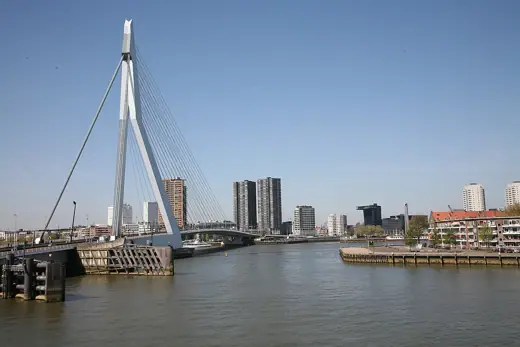
Erasmus Bridge
Key features802 m cable-stayed and bascule bridge; Ben van Berkel's design has one backward-leaning pylon.
About the building
The Erasmus Bridge spans the Nieuwe Maas in central Rotterdam, joining the north and south of the city. Ben van Berkel designed the 802-metre crossing, built from 1986 to 1996 as a cable-stayed bridge joined to a bascule section. Its cable-stayed part hangs from a single asymmetrical pale blue pylon, 139 metres tall, with a prominent horizontal base that earned the bridge the nickname "The Swan". At the southern end, an 89-metre bascule span lifts for ships too tall to pass beneath. During development, back stays were added to reduce bending, and the planned 150-m concrete pylon became a 139-m steel one, yet the overall look held, which decided its selection. Architects and engineers worked as equals. Two box girder spines anchor the cables and carry a deck of four traffic lanes, with two tram tracks between the spines.
Sources: Erasmusbrug (Wikipedia)
More by Ben van BerkelAll 3 →
More with structure as expressionAll 668 →
Find more with
Structure as expression668 buildings →Geometry1061 buildings →Water306 buildings →Infrastructure223 buildings →Each opens every building that shares the idea.
Details
- Architect
- Ben van Berkel (UNStudio)
- Place
- Rotterdam, Netherlands
- Year
- 1996
- Typology
- Infrastructure
- Movement
- Contemporary
- Region
- Europe

Go deeper




See all 9 links


More · InfrastructureAll 223 →
Portrait: WIA - What is architecture? · CC BY 3.0 · source