




Civic · Late modernism
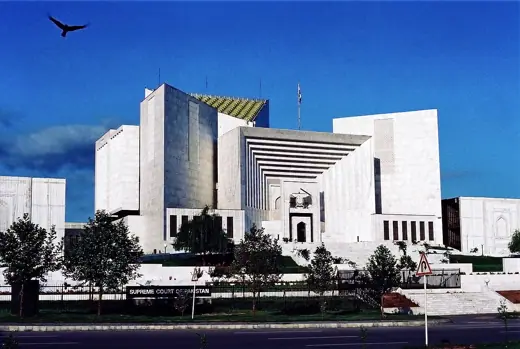
Supreme Court of Pakistan Building

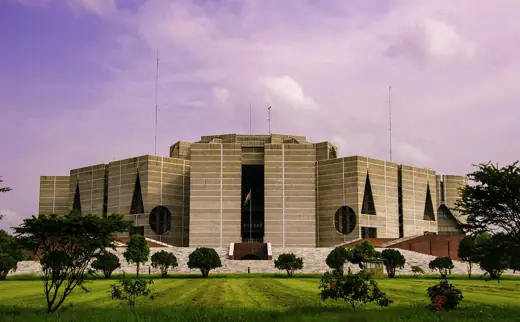
Key featuresStepped white blocks with a deep colonnaded portico on Constitution Avenue; Neoclassical and Modernist blend.
About the building
Kenzo Tange designed the Supreme Court Building in Islamabad in a modernist style that complements the Parliament Building nearby. It stands on Constitution Avenue, with the Prime Minister's Office on its southern side and, to its north, the Parliament Building and the Presidential Palace. Its construction was long, running from the 1960s, with the CDA's engineering department and the Environmental Protection Agency supervising the monument and its civil works. The court complex covers 339,861 square feet and is made up of three parts: a Main Central Block, a Judges' Chambers block and an Administrative Block. Its parts include judges' chambers, a law library, a range of meeting spaces and support services, including a lecture auditorium.
Sources: Supreme Court of Pakistan (Wikipedia)
More by Kenzō TangeAll 24 →
More with monumentalityAll 909 →

Find more with
Monumentality909 buildings →Geometry1061 buildings →Light & shadow431 buildings →Civic375 buildings →Each opens every building that shares the idea.
Details
- Place
- Islamabad, Pakistan
- Year
- 1993
- Typology
- Civic
- Movement
- Late modernism
- Region
- South Asia
Go deeper





See all 7 links

More · CivicAll 375 →

Portrait: Hans van Dijk for Anefo · CC BY-SA 3.0 nl · source