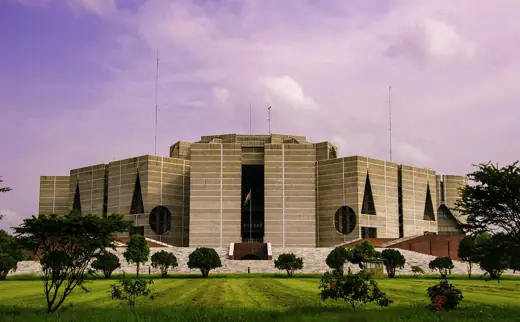
Key featuresGeometric cut-outs carve light into a concrete citadel set in a lake.
About the building
Louis Kahn designed the Jatiya Sangsad complex, seat of Bangladesh's National Assembly, initially for the Parliament of Pakistan. Spread over 210 acres (840,000 m2), it is among the world's largest legislative complexes, and Kahn planned all of it, lawns, lake and MPs' housing included. He aimed to express Bengali culture and heritage while using space well. Kahn died with it about three-quarters built; work went on under David Wisdom, who had worked for him, until its completion on 28 January 1982. The main building has nine blocks: eight outer ones of 110 feet and a central octagon of 155 feet. Huge walls are cut deep by porticoes and large geometric openings, and daylight bounces off surrounding walls and the octagonal drum into the Parliament Chamber. Water features echo Bangladesh's riverine landscape. It won the 1989 Aga Khan Award for Architecture.
The Jatiya Sangsad (JS, lit. 'National Parliament'), constitutionally the House of the Nation and commonly the Sangsad, is the unicameral legislative body of Bangladesh.
The parliament is housed in the Jatiya Sangsad Bhaban (lit. 'National Parliament Building'), located at Sher-e-Bangla Nagar in the Bangladeshi capital of Dhaka. Designed by the American architect Louis Kahn, the building is one of the largest legislative complexes in the world, comprising 200 acres (81 ha). Louis Kahn designed the entire Jatiya Sangsad complex, which includes lawns, lake and residences for the MPs. The main building, which is at the centre of the complex, is divided into three parts – the Main Plaza, South Plaza and Presidential Plaza.
The origin of the Jatiya Sangsad lies in the Constituent Assembly of Bangladesh (1972–73), which was the first parliament of Bangladesh responsible for the promulgation of the Constitution of Bangladesh. Since 1981, Jatiya Sangsad Bhaban, situated in Sher-e-Bangla Nagar, Dhaka, has been hosting the sessions of the Jatiya Sangsad.