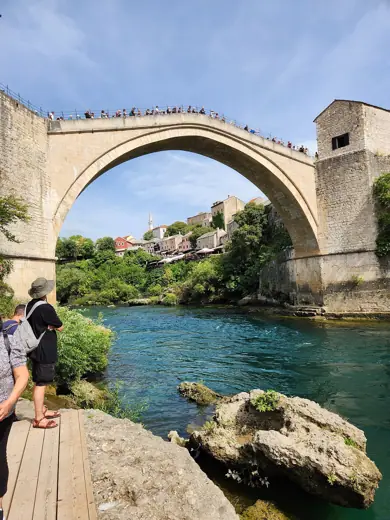
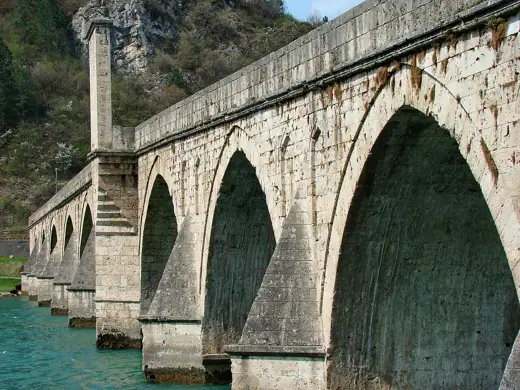
1/6 · Exterior · September 2023 in Bosnia and HerzegovinaPhoto: Rakoon · CC0 · source2/6 · Exterior · July 2009 Photograph published in the album "Mostar"Photo: Raphael Schön from Vienna, Austria · CC BY 2.0 · source3/6 · Exterior · Photograph published in the album "Mostar"Photo: Raphael Schön from Vienna, Austria · CC BY 2.0 · source4/6 · Exterior · Bosnia and Herzegovina, Mostar, Neretva river with Stari most bridge,Photo: Berthold Werner · CC BY-SA 4.0 · source5/6 · Interior · Innenstadt von Mostar mit Stari MostPhoto: MoserB · Public domain · source6/6 · Context · The Old Bridge ( Stari Most ) after sunsetPhoto: BáthoryPéter ( talk ) · CC BY-SA 3.0 · source
Key featuresSingle-arch stone Ottoman bridge by Mimar Hayruddin, a student of Sinan; rebuilt and reopened on 23 July 2004.
About the building
Stari Most spans the river Neretva and joins the two halves of Mostar, a city named after the mostari, keepers who guarded the bridge in Ottoman times. Suleiman the Magnificent ordered it in 1557, and its designer, Mimar Hayruddin, had trained under the architect Mimar Sinan. On completion it was the widest arch people had ever built. The hump-backed span is 30 metres long and 4 metres wide and rises 24 m above the water. Rather than foundations, it rests on limestone abutments tied into wing walls on the cliffs. Slobodan Praljak, commander of the Croat Defence Council, ordered its destruction, and shelling by Bosnian Croat forces brought it down on 9 November 1993. Rebuilt with the original methods and materials from 7 June 2001, it reopened on 23 July 2004, at an estimated cost of 15.5 million US dollars.
The Old Bridge (Serbo-Croatian: Stari most), also known as the Mostar Bridge, is a rebuilt 16th-century Ottoman bridge in the city of Mostar in Bosnia and Herzegovina. It crosses the river Neretva and connects the two parts of the city, which is named after the bridge keepers (mostari) who guarded the Old Bridge during the Ottoman era. Commissioned by Suleiman the Magnificent in 1557 and designed by Mimar Hayruddin, a student and apprentice of the architect Mimar Sinan, the Old Bridge is an exemplary piece of Balkan Islamic architecture.
During the Croat–Bosniak War, the Army of the Republic of Bosnia and Herzegovina (ARBiH) used the bridge as a military supply line, leading the Croatian Defence Council (HVO) to shell and destroy it on 9 November 1993. Subsequently, the bridge was reconstructed, and it reopened on 23 July 2004. In 2017, the International Criminal Tribunal for the former Yugoslavia (ICTY) deemed that the bridge was a legitimate military target.