




Office & tower · Postmodernism
SIS Building
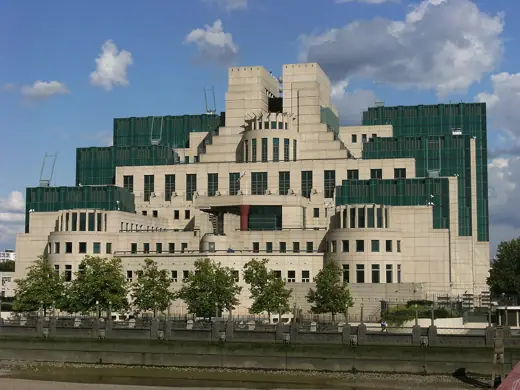
Key featuresStepped ziggurat of green glass and cream panels terracing down to the Thames.
About the building
Also called the MI6 Building, the SIS Building at Vauxhall Cross holds the headquarters of Britain's foreign intelligence service. It stands at 85 Albert Embankment, by Vauxhall Bridge on the Thames. Terry Farrell won a competition for the site; his first proposal was an urban village. His design looked to 1930s industrial modernism, Battersea and Bankside power stations among it, and to Mayan and Aztec temples. Its many layers create 60 separate roof areas; 25 kinds of glass went into it, and 12,000 m² of glass and aluminium in total. Because MI6's work is sensitive, large parts lie below street level, linked by underground corridors. It was finished in April 1994, and Queen Elizabeth II opened it on 14 July. In a favourable 1992 review in The Guardian, Deyan Sudjic called it an 'epitaph for the architecture of the eighties'.
Sources: SIS Building (Wikipedia)
More by Terry FarrellAll 2 →
More with monumentalityAll 909 →
Find more with
Monumentality909 buildings →Geometry1061 buildings →Water306 buildings →Office & tower349 buildings →Each opens every building that shares the idea.
Details
- Architect
- Terry Farrell
- Year
- 1994
- Typology
- Office & tower
- Movement
- Postmodernism
- Region
- Europe

Go deeper





See all 8 links


More · Office & towerAll 349 →
Portrait: Terry Farrell / Alan Williams · CC BY 3.0 · source