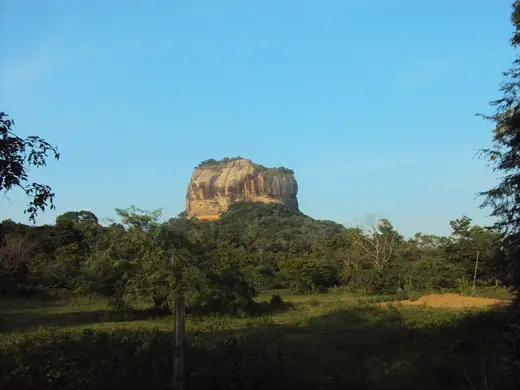
1/4 · Exterior · Sigiriya rock from a distancePhoto: Yourusernamewillbepublic2 · CC0 · source2/4 · Exterior · Climbing Lion rock fortressPhoto: Jean-Marc Astesana from Voisins le Bretonneux, France · CC BY-SA 2.0 · source3/4 · Exterior · Zona superior de Sigirya en Sri LankaPhoto: Iván Montoya · CC0 · source4/4 · InteriorPhoto: Alexis N. Vorontzoff · CC BY-SA 3.0 igo · source
Sigiriya or Sinhagiri (Lion Rock Sinhala: සීගිරිය, Tamil: சிகிரியா/சிங்ககிரி, ) is an ancient rock fortress located in the northern Matale District near the town of Dambulla in the Central Province, Sri Lanka. It is a site of historical and archaeological significance that is dominated by a massive column of granite approximately 180 m (590 ft) high.
According to the ancient Sri Lankan chronicle the Cūḷavaṃsa, this area was a large forest, then after storms and landslides it became a hill and was selected by King Kashyapa (CE 477–495) for his new capital. He built his palace on top of this rock and decorated its sides with colourful frescoes. On a small plateau about halfway up the side of this rock he built a gateway in the form of an enormous lion. The name of this place is derived from this structure; Sinhagiri, the Lion Rock.
The capital and the royal palace were abandoned after the king's death. It was used as a Buddhist monastery until the 14th century. Sigiriya today is a UNESCO listed World Heritage Site. It is one of the best preserved examples of ancient urban planning.