




Infrastructure · Modernism
Shukhov Tower

Key featuresStacked hyperboloid sections of straight steel members, each lifted up inside the last.
About the building
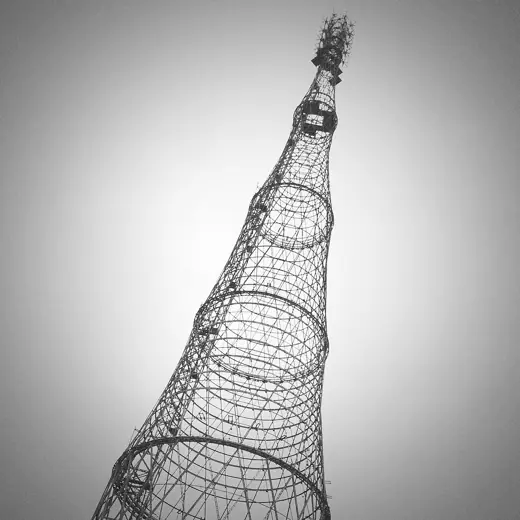
Vladimir Shukhov's broadcasting tower in Moscow, also called the Shabolovka Tower, comes out of the Russian avant-garde and went up from 1920 to 1922, during the Civil War. The first plan was a nine-section hyperbolic tower 350 metres tall, 15 metres more than the Eiffel Tower, weighing about 2,200 tons against the Eiffel Tower's 7,300. War and scarce resources forced the design down to 148.5 metres and 240 tons. Six sections sit one on another, each a separate single-cavity hyperboloid of rotation made from straight beams whose ends rest on circular foundations. The steel diagrid shell catches very little wind. It was raised without cranes or scaffolding, using only winches. After a campaign to save it, Russia's Ministry of Culture said it would stay standing, and in September 2014 Moscow City Council placed a preservation order on it.
Sources: Shukhov Tower (Wikipedia)
More by Vladimir ShukhovAll 6 →


More with structure as expressionAll 668 →
Find more with
Structure as expression668 buildings →Geometry1061 buildings →Prefabrication73 buildings →Infrastructure223 buildings →Each opens every building that shares the idea.
Details
- Place
- Moscow, Russia
- Year
- 1922
- Typology
- Infrastructure
- Movement
- Modernism
- Region
- Europe
Go deeper



More · InfrastructureAll 223 →

Portrait: Unknown author · Public domain · source