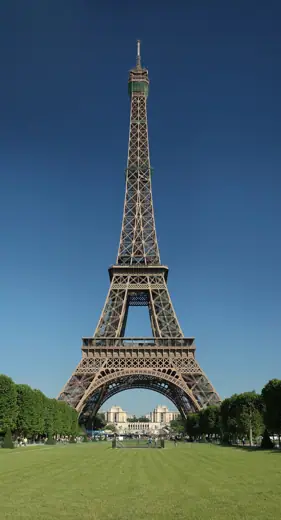
1/9 · Context · Eiffel Tower , seen from the Champ de Mars , Paris, FrancePhoto: Benh LIEU SONG · Public domain · source2/9 · Exterior · Looking up the center of the Eiffel TowerPhoto: Jebulon · CC0 · source3/9 · Exterior · Paris: The Eiffel Tower and the Champ de Mars ; with the La Défense business district in the backgroundPhoto: Wladyslaw (Taxiarchos228) · CC BY 3.0 · source4/9 · Exterior · Elevator of the Eiffel Tower in ParisPhoto: Another one of my pictures:
This photograph was taken by Medium69 (William Crocho · CC BY-SA 4.0 · source5/9 · InteriorPhoto: Unknown author · Public domain · source6/9 · Elevation · Plan of the 300m Eiffel towerPhoto: E. Monod · Public domain · source7/9 · Elevation · Drawing of Eiffeltower with technical dataPhoto: Alabasterstein based on File:Eiffel tower.svg · CC BY-SA 3.0 · sourcePhotos unavailable8/9G. Hentschel · Public domain · sourcePhotos unavailable9/9This image is available from the Brown University Library under the digital ID 1254146861593750 · Public domain · source
Portrait: François Touranchet · Public domain · source
About Eiffel Tower
The Eiffel Tower ( EYE-fəl; French: Tour Eiffel [tuʁ ɛfɛl] ) is a lattice tower on the Champ de Mars in Paris, France. It is named after the engineer Gustave Eiffel, whose company designed and built the tower from 1887 to 1889.
Locally nicknamed "La dame de fer" (French for "Iron Lady") for its use of wrought iron, it was constructed as the centrepiece of the 1889 World's Fair, and to crown the centennial anniversary of the French Revolution. Although initially criticised by some of France's leading artists and intellectuals for its design, it has since become a global cultural icon of France and one of the most recognisable structures in the world. The tower received 5,889,000 visitors in 2022. The Eiffel Tower is the most visited monument with an entrance fee in the world: 6.91 million people ascended it in 2015. It was designated a monument historique in 1964, and was named part of a UNESCO World Heritage Site ("Paris, Banks of the Seine") in 1991.