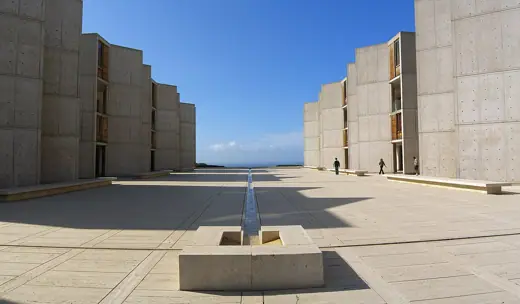
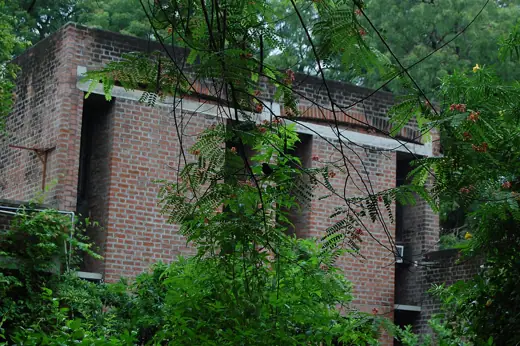
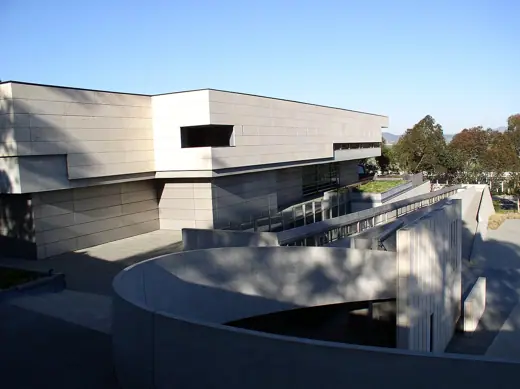
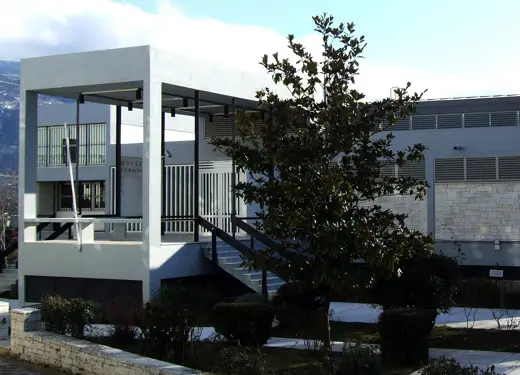
1/8 · Exterior · Salk Institute for Biological StudiesPhoto: Jason Taellious · CC BY-SA 2.0 · source2/8 · Exterior · The Salk Institute for Biological Studies is a famous modernist design by Louis Kahn , built in 1966Photo: Daniel L. Lu (user:dllu) · CC BY-SA 4.0 · source3/8 · Exterior · Salk Institute from interior courtyard in La Jolla, CAPhoto: Carol M. Highsmith · Public domain · source4/8 · ExteriorPhoto: Beyond My Ken · CC BY-SA 4.0 · source5/8 · InteriorPhoto: Beyond My Ken · CC BY-SA 4.0 · source6/8 · InteriorPhoto: Beyond My Ken · CC BY-SA 4.0 · source7/8 · Detail · Detail of the Salk Institute for Biological Studies , a modernist design by Louis Kahn, built in 1966Photo: Daniel L. Lu (user:dllu) · CC BY-SA 4.0 · source8/8 · Detail · Some chairs and a table at the Salk Institute for Biological StudiesPhoto: Daniel L. Lu (user:dllu) · CC BY-SA 4.0 · source
Key featuresLaboratories with service floors between them, around a travertine plaza open to the Pacific.
About the building
The Salk Institute stands on the Torrey Pines Mesa in La Jolla, on land San Diego granted after Salk and Louis Kahn asked for it in March 1960 and a referendum approved it that June. Salk wanted a beautiful campus to draw the world's best researchers. Kahn planned three clusters, for meetings, living and laboratories, but only the laboratories were built: two symmetric wings either side of a travertine-paved plaza. The two blocks frame a long view of the Pacific, accentuated by a thin linear fountain running towards the ocean. After two years, Kahn and the Institute switched from four narrow laboratory buildings of two floors to two wider ones of three. No walls divide the laboratories on any floor, to encourage collaboration. August Komendant re-engineered the structure and trained the builders to produce a highly refined concrete finish.
The Salk Institute for Biological Studies is a scientific research institute in the La Jolla community of San Diego, California. The independent, non-profit institute was founded in 1960 by Jonas Salk, the developer of the polio vaccine; among the founding consultants were Jacob Bronowski and Francis Crick. Construction of the research facilities began in spring of 1962. The Salk Institute consistently ranks among the top institutions in the US in terms of research output and quality in the life sciences.
The Salk Institute, La Jolla, California (1959–1965) was to be a campus composed of three clusters: meeting and conference areas, living quarters, and laboratories. Only the laboratory cluster, consisting of two parallel blocks enclosing a water garden, was built. The two laboratory blocks frame a long view of the Pacific Ocean, accentuated by a thin linear fountain that seems to reach for the horizon.
The campus was designed by Louis Kahn. Salk had sought a beautiful campus in order to draw the best researchers in the world. The original buildings of the Salk Institute were designated a historical landmark in 1991. The entire 27-acre (11 ha) site was deemed eligible by the California Historical Resources Commission in 2006 for listing in the US National Register of Historic Places. It is "arguably the defining work" of Kahn.