Potala Palace (Tibetan: ཕོ་བྲང་པོ་ཏ་ལ་, Wylie: pho brang po ta la; simplified Chinese: 布达拉宫; traditional Chinese: 布達拉宮; pinyin: Bùdálā Gōng) is a museum complex in Lhasa, the capital of the Tibet Autonomous Region of China. It was formerly the winter palace of the Dalai Lamas, and from 1649 until 1959 served as the Dalai Lamas' residence. The palace complex became a museum following the annexation of Tibet by the People's Republic of China.
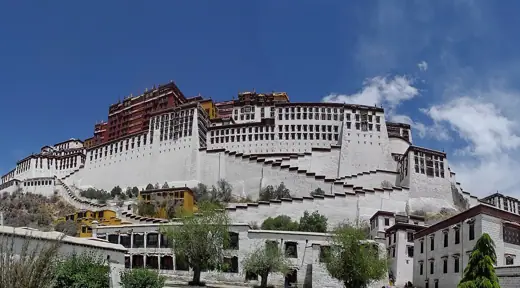
The Potala has inward-sloping walls with straight rows of many windows at the upper parts of the walls, and flat roofs at various levels. At the south base of the rock is a large space enclosed by walls and gates with great porticos on the inner side. A series of staircases with intervals leads to the summit of the rock. The whole width of this is occupied by the palace.
The central part of the group of buildings is a quadrangular terminating in gilt canopies similar to those on Jokhang Temple Monastery. The crimson coloured central member of Potala is called the "red palace" and contains the principal halls and chapels and shrines of past Dalai Lamas.
The colours: red, white, yellow, are caused by the application of limestone.