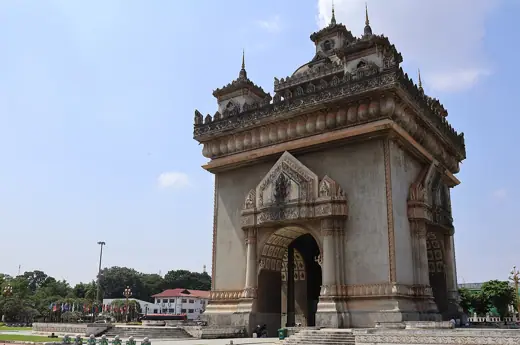
Patuxai is a war monument in Downtown Vientiane, Laos, built between 1957 and 1968. The Patuxai was dedicated to those who fought in the struggle for independence from France. In romanizing the name from the Laotian language, it is variously transliterated as Patuxai, Patuxay, Patousai and Patusai. It is also called Patuxai Arch or the Arc de Triomphe of Vientiane as it resembles the Arc de Triomphe in Paris. However, it is Laotian in design, decorated with mythological creatures.
The monument has five towers that represent the five principles of coexistence among nations of the world. They are also representative of the five Buddhist principles of “thoughtful amiability, flexibility, honesty, honor and prosperity”.
The monument has gateways on four sides oriented towards the four cardinal directions. The east–west gateways open to the Lane Xang Avenue, which is used during ceremonial national parades. In front of each gate, there is a pond. The four ponds represent the open section of a lotus flower (representing reverence of Laotians to the brave warriors of the nation). The four corners of the gateways are adorned by statues of a Naga King (mythical symbol of Laos), with a depiction signifying spraying of a jet of water (suggesting nature, fertility, welfare and happiness) into the ponds on the ground.