




Memorial · Art Deco
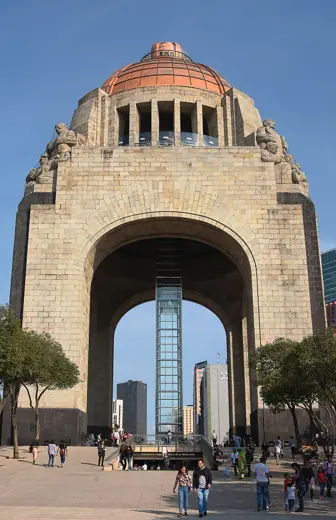
Monumento a la Revolución

Key features67 m memorial arch, the tallest triumphal arch in the world; built 1910–1938.
About the building
The Monument to the Revolution in Mexico City's Plaza de la República started out as another project. Porfirio Díaz appointed Émile Bénard, a French architect, to design a neoclassical building for the deputies and senators, meant to show Mexico as an advanced nation. It had an iron frame, and instead of local stone its front was to be faced in marble from Italy and granite from Norway. The Mexican Revolution stopped the work, leaving the shell unfinished for twenty-five years. Under President Lázaro Cárdenas, Carlos Obregón Santacilia, a Mexican architect, proposed converting the abandoned dome to honour the revolution's heroes. The new structure, mixing Mexican socialist realism with Art Deco, was finished in 1938. At 67 m (220 ft), no triumphal arch in the world is taller, and it is also a mausoleum for leading revolutionary figures.
Sources: Monumento a la Revolución (Wikipedia)
More with monumentalityAll 909 →
Find more with
Monumentality909 buildings →Axis319 buildings →Geometry1061 buildings →Memorial119 buildings →Each opens every building that shares the idea.
Details
Go deeper





See all 8 links


More · MemorialAll 119 →
Portrait: Original uploader was Rath5 at en.wikipedia · Public domain · source