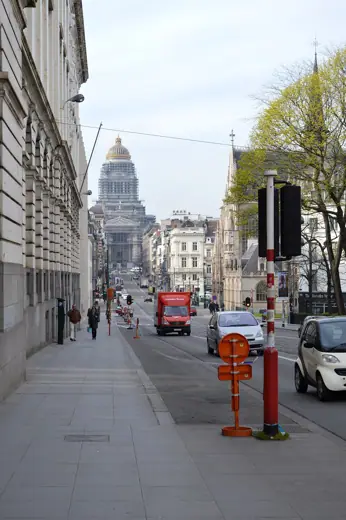
1/9 · Exterior · Infantry Memorial and Justice Palace, Brussels, BelgiumPhoto: Diego Delso · CC BY-SA 4.0 · source2/9 · Exterior · View of the Brussels Palace of Justice through the Regentschapsstraat / Rue de la RégencePhoto: DimiTalen · CC0 · source3/9 · Exterior · Dome of the Palace of Justice undergoing renovationsPhoto: Dennis G. Jarvis · CC BY-SA 2.0 · source4/9 · Exterior · Vue depuis un train sur le viaduc en briques entre la rue Terre-Neuve et le Boulevard du MidiPhoto: Stratoswift · CC BY-SA 4.0 · source5/9 · Interior · Coupole du Palais de justice de Bruxelles vue depuis le grand hall d'entréePhoto: M0tty · CC BY-SA 3.0 · source6/9 · Interior · Coupole du Palais de justice de Bruxelles vue depuis le premier étagePhoto: M0tty · CC BY-SA 3.0 · source7/9 · Section · Law Courts of BrusselsPhoto: Anonymous · Public domain · source8/9 · Elevation · Law Courts of BrusselsPhoto: Anonymous · Public domain · source9/9 · Elevation · Law Courts of BrusselsPhoto: Anonymous · Public domain · source
Portrait: scannage personnel · Public domain · source
About Palace of Justice
The Palace of Justice of Brussels or Law Courts of Brussels is a courthouse in Brussels, Belgium. It is the country's most important court building, seat of the judicial arrondissement of Brussels, as well as of several courts and tribunals, including the Court of Cassation (Belgian supreme court), the Court of Assizes (highest criminal court), the Court of Appeal of Brussels (appellate court), the Tribunal of First Instance of Brussels (general jurisdiction), and the Bar Association of Brussels.
Designed by the architect Joseph Poelaert, in an eclectic style of Greco-Roman inspiration, to replace an older courthouse, the current building was erected between 1866 and 1883. With a ground surface of 26,006 m2 (279,930 sq ft), the edifice is reputed to be the largest constructed in the 19th century and remains one of the largest of its kind. The total cost of the construction, land, and furnishings approximated 50 million Belgian francs. The building suffered heavy damage during World War II, when the cupola was destroyed and later rebuilt higher than the original. The structure has been under renovation since 1984 and scaffolding from that era still hangs on the building, though it is set to come down by 2035.