




Civic · Historic precedent
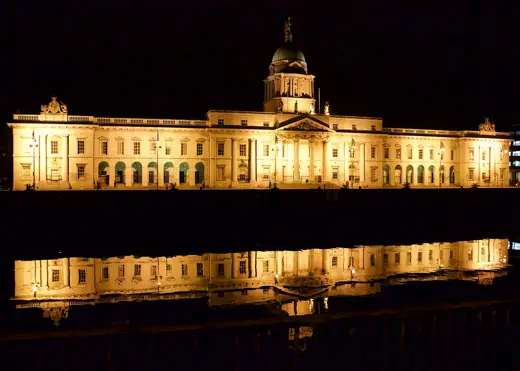
The Custom House
Key featuresFour facades with coats of arms and sculpture by Edward Smyth; darker Irish limestone dome.
About the building
Dublin's Custom House is an 18th-century neoclassical building, today home to the Department of Housing, Local Government and Heritage. John Beresford, who in 1780 became Ireland's first commissioner of revenue, came up with the project. When the original architect, Thomas Cooley, died, Beresford appointed James Gandon in 1781, giving him his first large-scale commission. Opposition was strong: Dublin Corporation and some merchants objected that it moved the city's axis, left shipping little space and stood on land that was then a swamp, and a mob of several thousand disrupted the laying of the foundations. Beresford ignored the protests. Gandon chose Irish artists as assistants, among them stone-cutter Henry Darley, and every available mason in the city was engaged. Coats of arms decorate all four facades, along with sculptures by Edward Smyth that stand for the rivers of Ireland.
Sources: The Custom House, Dublin (Wikipedia)
More by James GandonAll 2 →
More with axisAll 319 →

Find more with
Axis319 buildings →Stone524 buildings →Monumentality909 buildings →Civic375 buildings →Each opens every building that shares the idea.
Details
- Architect
- James Gandon
- Place
- Dublin, Ireland
- Year
- 1791
- Typology
- Civic
- Movement
- Historic precedent
- Region
- Europe

Go deeper





See all 8 links


More · CivicAll 375 →


Portrait: William Cuming (1769-1852) and Tilly Kettle (1735-1786) · Public domain · source