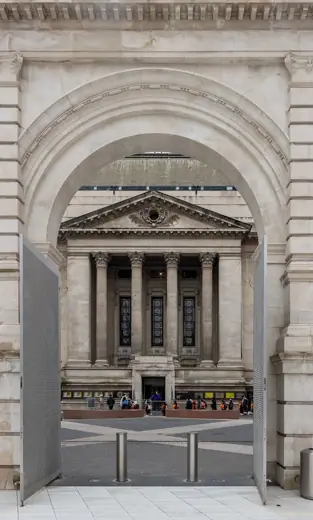
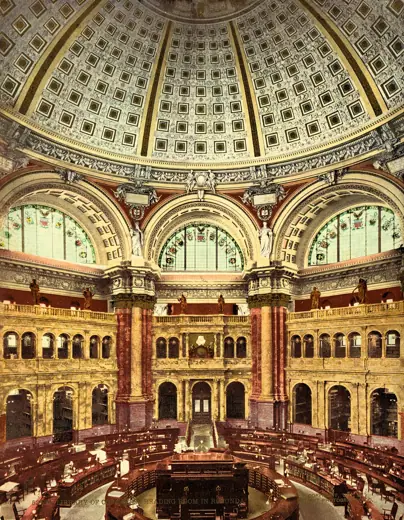
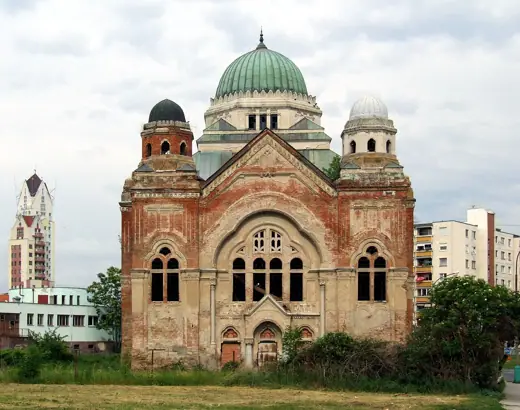
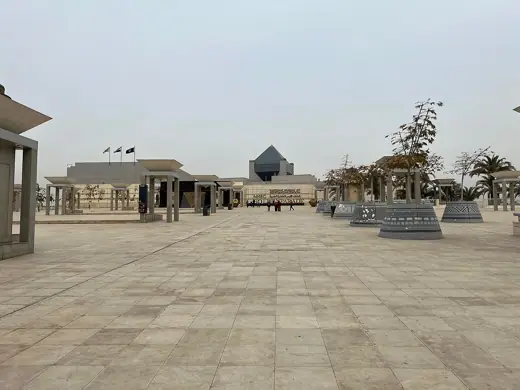
1/4 · Exterior · Looking through the gate from Victoria and Albert's Sackler Courtyard at the Natural History Museum, LondonPhoto: Photograph by Mike Peel ( www.mikepeel.net ) · CC BY-SA 4.0 · source2/4 · Exterior · Construction work outside the Natural History Museum, LondonPhoto: Photograph by Mike Peel ( www.mikepeel.net ) · CC BY-SA 4.0 · source3/4 · Exterior · July 2019Photo: Steve Elliott from UK · CC BY-SA 2.0 · source4/4 · Interior · London, 2017,Photo: Thomas Quine · CC BY 2.0 · source
Key featuresRomanesque front of terracotta moulded with plants and animals; iron-and-glass roof over the main hall.
About the building
London's Natural History Museum displays a huge range of natural history specimens. Its design competition was won by Captain Francis Fowke, a civil engineer, who died soon after, in December 1865. Alfred Waterhouse, hired in February 1866, took over the scheme, reworked the agreed plans substantially and gave the façades his own idiosyncratic Romanesque style, inspired by frequent trips to the Continent. Building ran from 1873 to 1880. Inside and out, terracotta tiles from Gibbs and Canning of Tamworth were used widely to resist the sooty air of Victorian London. The tiles and bricks carry many reliefs of plants and animals, living species in the west wing and extinct ones in the east. The vaulted central hall, sometimes called a cathedral of nature, held a large Diplodocus cast until 2017, when a blue whale skeleton took its place.
The Natural History Museum in London, England, is a museum that exhibits a vast range of specimens from various segments of natural history. It is one of three major museums on Exhibition Road in South Kensington, the others being the Science Museum and the Victoria and Albert Museum. The Natural History Museum's main frontage, however, is on Cromwell Road.
The museum is home to life and earth science specimens comprising some 80 million items within five main collections: botany, entomology, mineralogy, palaeontology and zoology. The museum is a centre of research specialising in taxonomy, identification and conservation. Given the age of the institution, many of the collections have great historical as well as scientific value, such as specimens collected by Charles Darwin. The museum is particularly famous for its exhibition of dinosaur skeletons and ornate architecture—sometimes dubbed a cathedral of nature—both exemplified by the large Diplodocus cast that dominated the vaulted central hall before it was replaced in 2017 with the skeleton of a blue whale hanging from the ceiling. The Natural History Museum Library contains an extensive collection of books, journals, manuscripts, and artwork linked to the work and research of the scientific departments; access to the library is by appointment only.