




Museum · Regionalism
National Museum of the American Indian
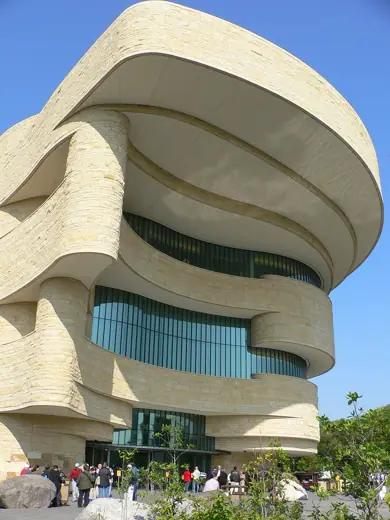
Key featuresCurving tiers of rough limestone evoke wind-carved rock around a domed central gathering space.
About the building
This Smithsonian museum is given over to the cultures of the Americas' Indigenous peoples. Its architect and project designer was the Canadian Douglas Cardinal (Blackfoot), with GBQC Architects of Philadelphia and Johnpaul Jones (Cherokee/Choctaw) as design architects. Disputes during construction led to Cardinal's removal, yet the building keeps his original intent. Opened on 21 September 2004 after fifteen years in the making, it was the country's first national museum solely for Native Americans. Golden Kasota limestone clads the curving five-storey building, meant to recall rock worn by wind and water over millennia, and simulated wetlands surround it. Its east-facing entrance, prism window and 120-foot-high space for Native performance came from wide consultation with Native peoples. Inside, curved walls leave almost no sharp corners.
Sources: National Museum of the American Indian (Wikipedia)
More by Douglas CardinalAll 2 →
More with sculptural formAll 769 →
Find more with
Sculptural form769 buildings →Stone524 buildings →Landscape736 buildings →Museum735 buildings →Each opens every building that shares the idea.
Details
- Architect
- Douglas Cardinal
- Place
- Washington, D.C., United States
- Year
- 2004
- Typology
- Museum
- Movement
- Regionalism
- Region
- Americas

Go deeper




See all 9 links


More · MuseumAll 735 →
Portrait: Bruce Reeve · CC BY-SA 2.0 · source