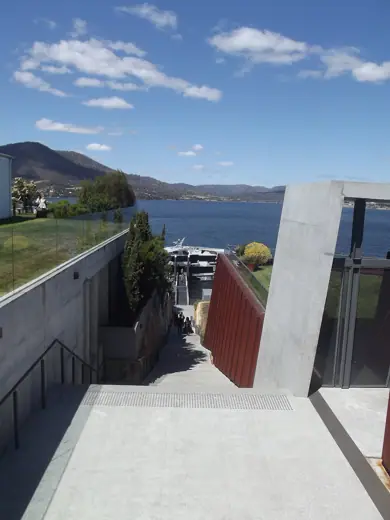
Key featuresGalleries carved underground into sandstone cliffs, reached by a spiral stair down from the entry.
About the building
Inside the Moorilla winery on Hobart's Berriedale peninsula in Tasmania, MONA, the Museum of Old and New Art, is the biggest privately paid-for museum in the Southern Hemisphere. It opened officially in January 2011. From the street the one-storey building seems dwarfed by its surroundings, but a spiral staircase inside descends to three bigger levels of maze-like galleries cut into the peninsula's cliffs. By one account, it was put mostly underground to spare the historic setting of two houses on the site designed by Roy Grounds. It has no windows and feels ominous on purpose. Visitors see the art while working back up toward the surface, a route some have set against the downward spiral of New York's Guggenheim Museum. Most arrive on the ferry up the Derwent. It won the 2012 Sir Zelman Cowen Award for Public Architecture.
The Museum of Old and New Art (MONA) is an art museum located within the Moorilla winery on the Berriedale peninsula in Hobart, Tasmania, Australia. It is the largest privately funded museum in the Southern Hemisphere. MONA houses ancient, modern and contemporary art from the David Walsh collection. Noted for its central themes of sex and death, the museum has been described by Walsh as a "subversive adult Disneyland".
The single-storey MONA building appears at street level to be dominated by its surroundings, but its interior possesses a spiral staircase that leads down to three larger levels of labyrinthine display spaces built into the side of the cliffs around Berriedale peninsula. The decision to build it largely underground was taken, according to Walsh, to preserve the heritage setting of the two Roy Grounds houses on the property. Walsh has also said that he wanted a building that "could sneak up on visitors rather than broadcast its presence ... 'a sense of danger' that would enliven the experience of viewing art". Most visitors approach by ferry up the River Derwent.