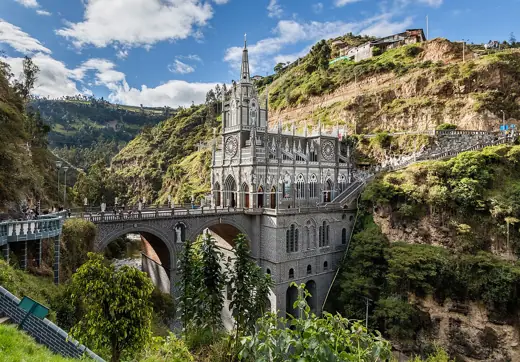
Key featuresGothic Revival church set on an arched bridge across a river gorge, its altar against the cliff.
About the building
The basilica of Las Lajas, a Roman Catholic minor basilica, stands within the Guáitara River canyon at Ipiales in Colombia. It was designed by Lucindo María Espinosa Medina (1871–1945), a self-taught cabinetmaker, builder and architect from Pasto in Nariño. The present church, in a neo-Gothic style, was begun on 1 January 1916 and paid for with gifts from local worshippers. It rises 100 m from the floor of the canyon, and a bridge 50 m tall links it to the far side. Pilgrims come from Colombia and neighbouring Ecuador because of a Marian apparition said to have happened in the 18th century. The first shrine on the spot, of straw and wood, dates from the middle of that century, and a brick chapel 7 m long replaced it in 1795/96.
The Sanctuary of Las Lajas (in full Sanctuary of Our Lady of the Holy Rosary of Las Lajas) is a Catholic minor basilica located within the canyon of the Guáitara River in Ipiales, Nariño Department, Colombia. The Marian shrine is dedicated to the Blessed Virgin Mary as Our Lady of the Rosary. The architect was Lucindo Maria Espinosa Medina.
Pious believers claim that the colorful Madonna and Child image displayed on the rock wall is of divine origin, and that it was formed without human intervention. The current church was built in a neo-gothic architectural style between 1916 and 1949. The name Laja is Spanish for a flagstone, and comes from the name of a type of flat sedimentary rock.
Pope Pius XII granted a Pontifical Decree of coronation to the image as Sancta Virgo de Rupe (English: Holy Virgin of the Rock) on 31 May 1951. He also raised the Marian shrine to the status of a Minor basilica via his decree Templum per Decorum on 30 August 1954. Pope Paul VI granted the Marian title as the Virgin of the Holy Rosary as the Patroness of Ipiales via his decree Tutela Cælestis Virtutis on 26 April 1965.