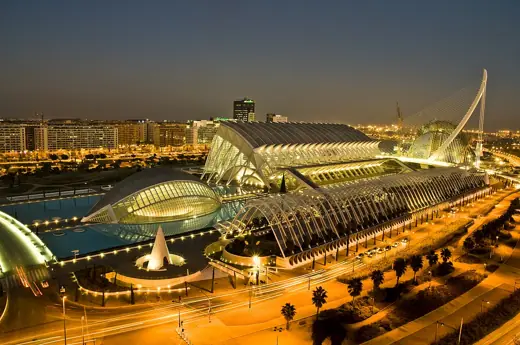
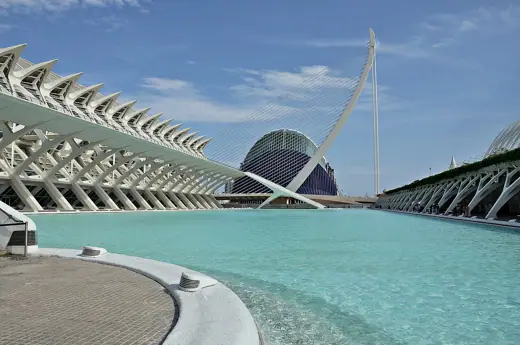
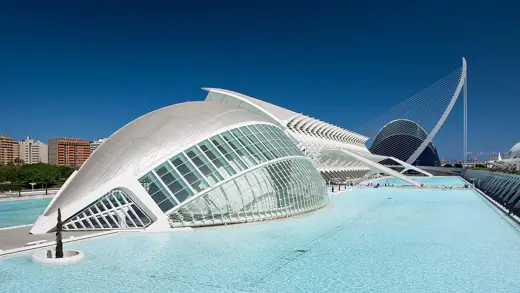
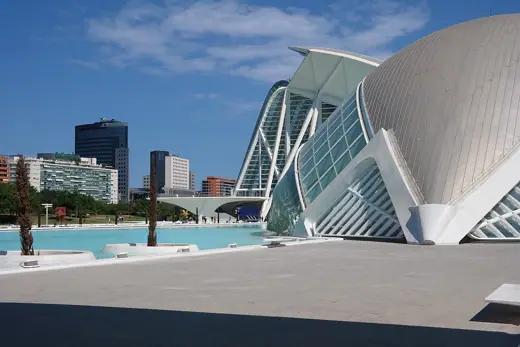
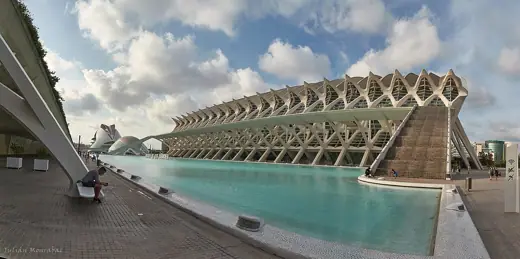
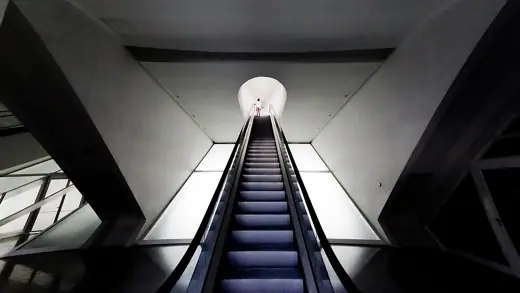
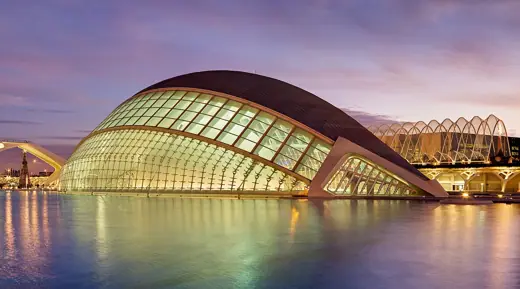
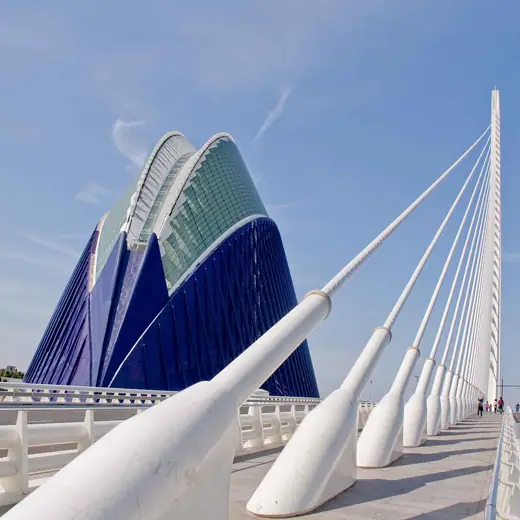
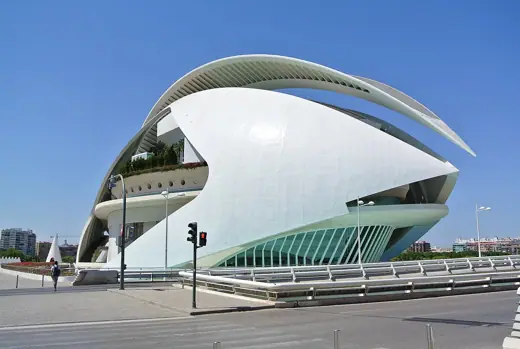
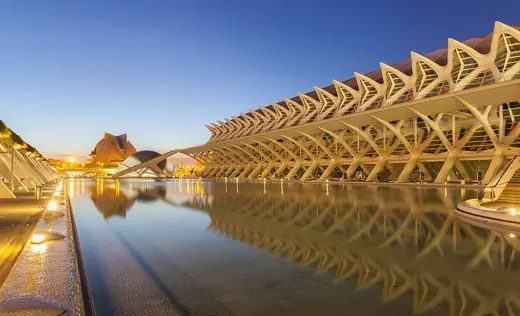
1/6 · Context · Una panorámica de la Ciudad de las Ciencias y las Artes de ValenciaPhoto: Jcca76 · CC BY-SA 4.0 · source2/6 · Exterior · valencia-2009Photo: Alberto-g-rovi · CC BY-SA 3.0 · source3/6 · ExteriorPhoto: kuhnmi · CC BY 2.0 · source4/6 · Exterior · Parts of the by Santiago Calatrava designed City of Arts and Sciences Valencia in 2014Photo: Choinowski · CC BY-SA 4.0 · source5/6 · Interior · Ciudad de las Ciencias y las Artes (Valencia)Photo: Julián Monrabal · CC0 · source6/6 · Interior · Valencia, SpainPhoto: Hernán Piñera from Marbella · CC BY-SA 2.0 · source
Culture & sport · Contemporary
City of Arts and Sciences
Santiago Calatrava · Valencia, Spain · 1998
Key featuresWhite concrete and steel ribbed buildings lined up along a former riverbed with pools.
The City of Arts and Sciences (Valencian: Ciutat de les Arts i les Ciències, Spanish: Ciudad de las Artes y las Ciencias) is a cultural and architectural complex in the city of Valencia, Spain. It is the most important modern tourist destination in the city of Valencia and one of the 12 Treasures of Spain.
The City of Arts and Sciences is situated at the southeast end of the former riverbed of the river Turia, which was drained and rerouted after a catastrophic flood in 1957. The old riverbed was turned into a picturesque sunken park.
Designed by Santiago Calatrava and Félix Candela, the project began the first stages of construction in July 1996, and was inaugurated on 16 April 1998 with the opening of L'Hemisfèric. The last major component of the City of Arts and Sciences, Palau de les Arts Reina Sofía, was inaugurated on 9 October 2005, Valencian Community Day. The most recent building in the complex, L'Àgora, was opened in 2009.
Originally budgeted at €300 million in 1991 for three structures, additional structures were added, contributing to a three-fold increase from that initial expected cost.




.jpg)

.jpg)
.jpg)